
Looking for SEO services in India? Learn how to choose the right SEO company, agency or expert for technical SEO, local SEO, eCommerce SEO and long-term organic growth.
SEO Services in India: The Complete Guide to Choosing an SEO Company, Agency or Expert in 2026
Search visibility has become one of the most valuable digital assets a business can build.
Every day, potential customers use Google and other search platforms to research products, compare businesses, find local providers, evaluate solutions and make purchasing decisions. Increasingly, discovery also happens through AI-powered search experiences, answer engines and conversational assistants.
For businesses, this creates both an opportunity and a challenge.
The opportunity is enormous: a website that consistently appears for commercially relevant searches can attract prospective customers precisely when they are looking for information, products or services.
The challenge is that sustainable search visibility is rarely achieved by publishing a few articles or inserting keywords into existing pages.
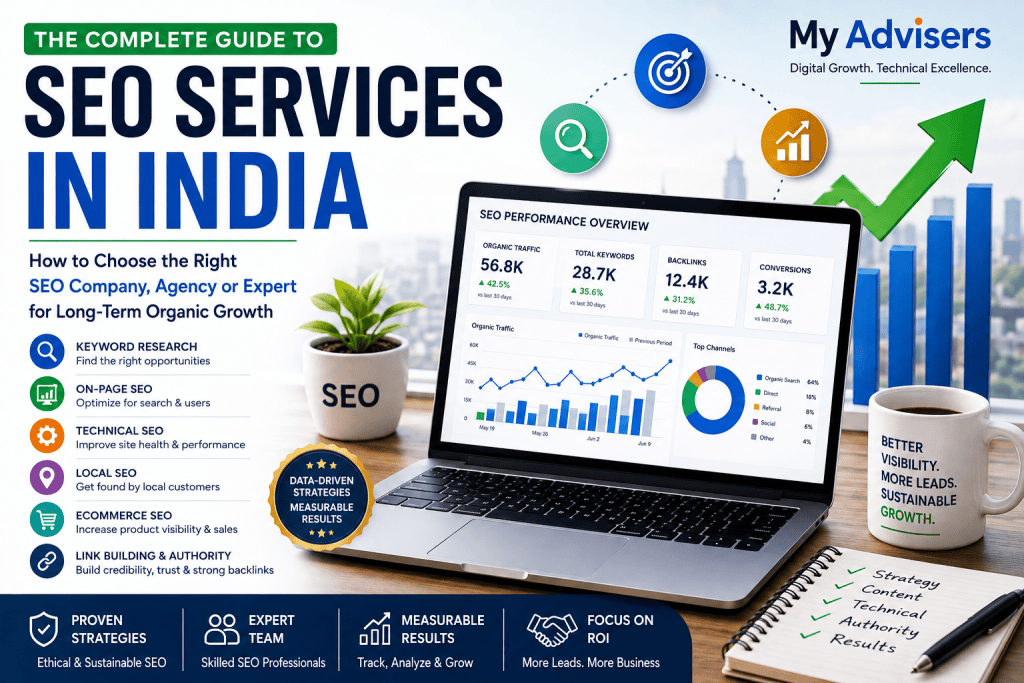
Modern search engine optimization requires a coordinated strategy involving technical SEO, content quality, search intent, website architecture, user experience, authority building, structured data, local visibility, analytics and continuous improvement.
This comprehensive guide from My Advisers explains how professional SEO services work, what businesses should expect from an SEO company or SEO agency, how to evaluate an SEO expert in India, and how different SEO strategies—including local SEO, eCommerce SEO, technical SEO and small-business SEO—fit together.
Whether you are building a new website, trying to improve an established business, recovering declining organic visibility or evaluating SEO agencies in India, this guide is designed to help you make better-informed decisions.
What Is SEO?
SEO, or Search Engine Optimization, is the process of improving a website so that its relevant pages can be discovered, understood and surfaced more effectively by search engines for searches related to the website’s purpose.
SEO includes much more than keywords.
A comprehensive SEO strategy can involve:
- technical website improvements;
- keyword and audience research;
- search-intent analysis;
- content planning;
- on-page optimization;
- internal linking;
- website architecture;
- local search optimization;
- eCommerce optimization;
- digital authority development;
- structured data;
- page experience;
- conversion optimization;
- performance measurement; and
- ongoing content improvement.
The ultimate objective should not simply be to “rank #1.”
A commercially useful SEO strategy connects search visibility with meaningful business outcomes.
Those outcomes might include:
- qualified website visitors;
- enquiries;
- phone calls;
- appointment requests;
- product sales;
- software sign-ups;
- downloads;
- subscriptions;
- store visits; or
- other measurable conversions.
This distinction is critical.
A website can generate thousands of organic visits without generating meaningful business results if it ranks for the wrong searches.
Good SEO therefore begins with understanding who the business wants to reach, what those people search for, what they need at each stage of their decision journey, and what action the website should help them take next.
Why SEO Matters for Businesses in India
India has a vast and increasingly digital consumer and business economy.
Customers frequently research businesses online before contacting them. B2B decision-makers compare service providers. Consumers evaluate reviews and product information. Local customers search for nearby solutions. Entrepreneurs research software and professional services.
This means search visibility can influence customer acquisition across numerous industries.
Consider searches such as:
- SEO services in India;
- web development company;
- digital marketing services;
- software development company;
- accountant near me;
- restaurant near me;
- business consultant;
- eCommerce development services;
- local service provider;
- online software solution.
Each query reflects a different need and level of commercial intent.
A business that understands these differences can build pages that match those needs instead of attempting to rank one generic homepage for everything.
SEO Can Create Compounding Value
Paid advertising generally requires ongoing expenditure to continue buying traffic.
SEO is different.
An authoritative page that earns sustainable visibility may continue attracting relevant visitors long after its initial publication.
That does not mean SEO traffic is free.
Professional SEO requires investment in strategy, research, technology, content, website improvements and expertise.
However, successful SEO can create digital assets whose value compounds over time.
A strong service page can gain authority.
A useful guide can earn references.
An effective internal-link structure can strengthen an entire topic cluster.
A technically sound website can make future content easier for search engines to discover and understand.
SEO is therefore better viewed as long-term digital infrastructure than as a one-time marketing activity.
What Are Professional SEO Services?
Professional SEO services are structured activities designed to improve a website’s organic search performance and its ability to turn relevant search demand into business results.
The exact scope depends on the website, market and objectives.
A comprehensive SEO engagement may include:
- SEO audit
- keyword research
- competitor research
- search-intent mapping
- technical SEO
- on-page SEO
- content strategy
- content optimization
- internal linking
- website architecture
- local SEO
- eCommerce SEO
- authority development
- structured data implementation
- analytics and conversion tracking
- reporting
- continuous testing and improvement
These components should work together.
For example, excellent content cannot reach its potential if important pages are accidentally blocked from crawling.
Likewise, technically perfect pages will not automatically perform if they fail to satisfy search intent.
SEO is a system.
What Does an SEO Company Do?
An SEO company helps organizations improve their visibility across organic search results through research, optimization, technical improvements, content development and performance analysis.
A capable SEO company should begin by understanding the business rather than immediately changing title tags or building links.
Important initial questions include:
- What does the company sell?
- Who are its ideal customers?
- Which locations does it serve?
- Which services are most profitable?
- Which competitors dominate relevant searches?
- What does the current website rank for?
- Which pages already generate leads?
- Where are the technical problems?
- Which topics demonstrate genuine expertise?
- What conversions matter?
- How will performance be measured?
The answers determine the strategy.
A national eCommerce website, for example, requires a very different SEO approach from a local professional-services business.
SEO Company vs SEO Agency vs SEO Consultant
Businesses frequently search for an SEO company, SEO agency, SEO consultant, SEO specialist or SEO expert.
These terms overlap, but the service models can differ.
SEO Company
An SEO company typically operates as an organization with multiple specialists or a broader delivery team.
It may provide:
- SEO strategy;
- technical audits;
- content planning;
- on-page optimization;
- link and authority analysis;
- local SEO;
- reporting; and
- related digital services.
This model can be useful when a project requires multiple skill sets.
SEO Agency
An SEO agency may provide similar services but often works within a broader marketing framework.
Depending on the agency, services might extend into:
- paid search;
- social advertising;
- content marketing;
- web development;
- conversion optimization;
- analytics; and
- creative services.
The terms “SEO company” and “SEO agency” are often used interchangeably.
Businesses should therefore evaluate capabilities and processes rather than labels.
SEO Consultant
An SEO consultant typically provides strategic or specialist guidance.
A consultant might:
- audit a website;
- diagnose traffic losses;
- create an SEO roadmap;
- advise internal teams;
- oversee migrations;
- perform keyword research;
- design content architecture; or
- provide technical recommendations.
Consulting can be especially appropriate when a business already has internal developers, writers or marketers capable of implementing recommendations.
SEO Expert or SEO Specialist
An SEO expert or specialist may work independently, inside an agency or as part of an internal marketing team.
The title itself is not proof of expertise.
Businesses should evaluate demonstrated methodology, communication, technical understanding and ethical practices rather than relying on titles such as “expert.”
How to Choose an SEO Company in India
Choosing an SEO company should involve more than comparing monthly prices.
SEO affects website architecture, content, reputation and potentially revenue. Poor implementation can waste resources or create long-term problems.
Here are important factors to evaluate.
1. Understand Their SEO Process
Ask how the company approaches a new project.
A credible process should normally include some combination of:
- discovery;
- website analysis;
- technical audit;
- keyword research;
- competitor analysis;
- search-intent analysis;
- strategy development;
- implementation priorities;
- measurement; and
- ongoing improvement.
Be cautious when the entire strategy appears to consist of “submitting backlinks” or “adding keywords.”
2. Ask How Success Is Measured
Rankings matter, but rankings alone are insufficient.
SEO measurement can include:
- organic impressions;
- clicks;
- qualified organic traffic;
- non-brand visibility;
- conversions;
- leads;
- revenue;
- engagement;
- local actions;
- indexed pages;
- crawl health; and
- conversion rate.
The appropriate metrics depend on the business.
3. Evaluate Transparency
A business should understand what work is being performed.
Ask:
- What will be changed?
- Who owns the content?
- Who owns created assets?
- Will you receive reports?
- Which tools are used?
- Are links purchased?
- Will changes require approval?
- What access is required?
- How are risks handled?
Transparency is especially important when an external provider receives access to Google Search Console, Analytics, WordPress or other business systems.
4. Avoid Guaranteed Rankings
No ethical SEO company controls Google’s rankings.
Search results depend on numerous factors, including competitors, algorithms, website quality, intent and search context.
Statements such as:
“Guaranteed #1 ranking on Google”
should therefore be treated cautiously.
A responsible SEO provider can explain strategy, opportunities, deliverables and measurable objectives.
It cannot legitimately guarantee control over Google’s search results.
5. Evaluate Communication
SEO is ongoing.
Businesses should know:
- what has been completed;
- what changed;
- why it changed;
- what was learned;
- what comes next; and
- what decisions require business input.
Clear communication is often as important as technical expertise.
How My Advisers Approaches SEO
At My Advisers, SEO should begin with the relationship between the business, its audience and real search demand.
Instead of treating SEO as a checklist of isolated tasks, the objective is to connect:
Business goals → customer needs → search intent → website architecture → useful content → technical accessibility → authority → conversions → measurement.
This framework helps avoid a common SEO mistake: optimizing for traffic without understanding whether that traffic has commercial value.
Our broader digital and technical perspective also recognizes that SEO does not exist independently of the website.
Search performance can be influenced by:
- website development;
- information architecture;
- performance;
- analytics;
- content quality;
- conversion design;
- automation;
- technical infrastructure; and
- broader digital strategy.
SEO therefore works best when optimization decisions are connected with the overall digital system.
Step 1: SEO Discovery and Business Analysis
Before keyword research, businesses need clarity.
An SEO discovery process should establish:
Business objectives
What is SEO expected to accomplish?
Possible objectives include:
- increase enquiries;
- sell more products;
- generate qualified leads;
- increase local discovery;
- build brand awareness;
- enter new markets;
- improve product discovery; or
- reduce dependency on paid acquisition.
Target audience
Who should find the website?
Audience analysis can consider:
- customer type;
- industry;
- business size;
- geographic location;
- problems;
- purchasing stage;
- language; and
- decision criteria.
Priority services
Not every product or service deserves equal SEO investment.
Businesses should identify:
- highest-margin services;
- strategically important services;
- scalable offerings;
- areas with strong customer demand; and
- categories where the business has genuine expertise.
This information helps prioritize keyword research.
Step 2: SEO Audit
An SEO audit is a systematic assessment of factors that may affect organic search performance.
A professional SEO audit should lead to prioritized action—not merely produce a long list of automated warnings.
Technical Audit
Technical checks may include:
- crawl accessibility;
- robots.txt;
- XML sitemaps;
- canonical tags;
- redirects;
- status codes;
- duplicate URLs;
- pagination;
- JavaScript rendering;
- mobile compatibility;
- Core Web Vitals;
- HTTPS;
- site architecture;
- internal linking;
- structured data;
- orphan pages;
- indexability;
- page templates; and
- server performance.
Content Audit
A content audit evaluates existing pages for:
- usefulness;
- accuracy;
- search intent;
- duplication;
- outdated information;
- topical coverage;
- cannibalization;
- thin content;
- organic performance; and
- conversion relevance.
Pages may then be categorized as:
- keep;
- improve;
- consolidate;
- redirect;
- update;
- expand; or
- remove where genuinely appropriate.
Deletion should not be treated casually because existing URLs may have links, rankings or historical value.
Step 3: Keyword Research
Keyword research identifies the language people use when searching for information, products and services.
Professional keyword research should evaluate much more than monthly search volume.
Useful factors include:
- search intent;
- relevance;
- commercial value;
- competition;
- SERP composition;
- geographic relevance;
- business fit;
- conversion potential;
- seasonality; and
- existing website authority.
Search Volume Is Not Everything
Suppose Keyword A receives 50,000 searches per month while Keyword B receives 500.
Keyword A might look more attractive.
But if Keyword A is broad and informational while Keyword B is closely connected to a high-value service, Keyword B could produce significantly greater business value.
The best keyword strategy balances demand with intent and relevance.
Understanding Search Intent
Search intent describes what a user is trying to accomplish.
It is one of the most important concepts in modern SEO.
Informational Intent
The searcher wants knowledge.
Examples:
- what is SEO;
- how does SEO work;
- technical SEO guide;
- how to improve website ranking.
These searches are valuable for education and awareness.
Commercial Investigation
The searcher is comparing solutions.
Examples:
- best SEO company in India;
- SEO agency vs freelancer;
- best SEO services for small business;
- SEO company reviews.
These queries may occur relatively close to a purchase decision.
Transactional Intent
The user appears ready to take action.
Examples:
- hire SEO expert;
- SEO services India;
- SEO consultant India;
- local SEO services;
- eCommerce SEO services.
These searches are particularly important for service businesses.
Navigational Intent
The user is trying to reach a particular website or brand.
For example:
- Google Search Console;
- Semrush login;
- My Advisers.
SEO strategies should distinguish among these intents rather than treating every keyword equally.
Keyword Mapping: One Search Intent, One Appropriate Destination
Keyword mapping assigns keyword groups to relevant pages.
For example:
| Search Theme | Appropriate Page |
|---|---|
| SEO services | Main SEO service page |
| Local SEO services | Local SEO page |
| eCommerce SEO services | eCommerce SEO page |
| Technical SEO services | Technical SEO page |
| SEO audit services | SEO audit page |
| Small business SEO | Small-business SEO page |
| What is technical SEO? | Educational guide |
This prevents a website from attempting to rank its homepage for every search.
It also reduces keyword cannibalization, where several pages compete for substantially the same intent.
On-Page SEO Services
On-page SEO focuses on improving individual pages and their relationship with the rest of the website.
Important elements include:
Title Tags
A title should clearly describe the page while remaining useful to searchers.
Keyword usage should be natural.
Meta Descriptions
Meta descriptions do not need to be stuffed with keywords.
Their primary purpose is to communicate relevance and encourage qualified searchers to visit the page.
Heading Structure
Headings organize information.
A logical hierarchy helps users scan content and can help search systems understand the relationship among topics.
Main Content
High-quality content should answer the user’s need comprehensively.
Length alone does not determine quality.
A 5,000-word page that repeatedly says the same thing can be less useful than a focused 1,500-word page.
Content should be as detailed as necessary to satisfy the topic.
Images
Relevant images can improve explanation and engagement.
Images should use:
- descriptive filenames where appropriate;
- meaningful alternative text when needed for accessibility;
- appropriate dimensions;
- compression; and
- suitable modern formats.
Alt text should describe the image—not serve as a place to insert lists of keywords.
Internal Links
Internal links help visitors discover related information and establish relationships between pages.
Descriptive anchor text is generally more useful than repetitive “click here” links.
Technical SEO Services
Technical SEO ensures that a website provides a strong technical foundation for search visibility, including crawlability, indexing, site architecture, performance and structured technical signals.
Crawling
Search engines must be able to discover accessible pages.
Crawl problems can arise from:
- broken internal links;
- robots.txt restrictions;
- incorrect noindex directives;
- poor architecture;
- redirect chains; or
- JavaScript implementation.
Indexing
Crawling does not guarantee indexing.
Search engines decide which pages should be included in their indexes.
Indexation problems may arise from:
- duplicate pages;
- canonicalization;
- low-value content;
- soft 404s;
- accidental noindex tags;
- redirects;
- rendering problems; or
- other quality and technical signals.
Canonicalization
Canonical tags help indicate preferred URLs among duplicate or substantially similar pages.
Incorrect canonical implementation can cause important pages to be treated as duplicates.
XML Sitemaps
XML sitemaps help search engines discover canonical URLs that a website wants indexed.
A sitemap should generally contain clean, indexable URLs rather than redirects, error pages or intentionally excluded pages.
HTTPS
Secure HTTPS connections are essential for modern websites.
Mobile Experience
Search users frequently browse from mobile devices.
Responsive layouts, readable typography, accessible navigation and appropriately sized interactive elements contribute to usability.
Core Web Vitals
Core Web Vitals evaluate important aspects of page experience.
Common metrics include:
- Largest Contentful Paint (LCP) — loading performance;
- Interaction to Next Paint (INP) — responsiveness;
- Cumulative Layout Shift (CLS) — visual stability.
Improving these metrics can also improve user experience beyond SEO.
Website Architecture and SEO
A logical website structure helps users and search engines understand how pages relate to one another.
A service website might use:
Home
→ SEO Services
→ Local SEO
→ Technical SEO
→ eCommerce SEO
→ SEO Audit
Digital Marketing
→ Google Ads
→ Content Marketing
→ Analytics
Web Development
→ WordPress Development
→ eCommerce Development
→ Website Maintenance
Resources
→ SEO Guides
→ Digital Marketing Guides
→ Web Development Guides
This creates recognizable topical relationships.
Good architecture also avoids excessive depth. Important pages should generally be reasonably easy to reach through internal navigation.
Content Strategy for SEO
Content marketing and SEO are closely connected, but publishing large quantities of generic content is not a sustainable strategy.
Useful SEO content should address genuine audience needs.
Build Topic Clusters
Instead of writing disconnected articles, businesses can develop clusters around areas where they possess expertise.
For an SEO topic, a cluster might include:
Pillar
Complete SEO Guide
Supporting content
- Technical SEO Guide
- Local SEO Guide
- eCommerce SEO Guide
- Keyword Research Guide
- Internal Linking Guide
- SEO Audit Guide
- Search Intent Guide
- Google Search Console Guide
- Core Web Vitals Guide
These pages can link contextually to one another.
This creates a useful learning resource for visitors while establishing clear topical relationships.
Google’s E-E-A-T Concepts and SEO
E-E-A-T stands for:
Experience, Expertise, Authoritativeness and Trustworthiness.
Google’s quality-evaluation documentation uses these concepts when discussing page and content quality.
E-E-A-T should not be treated as a mechanical “formula” or a single ranking score.
Instead, it provides useful principles for creating trustworthy content.
Experience
Where relevant, demonstrate first-hand or practical experience.
Examples include:
- original observations;
- real processes;
- case studies;
- screenshots;
- practical examples;
- lessons learned;
- product testing; and
- implementation experience.
Expertise
Content should demonstrate subject knowledge appropriate to the topic.
Expertise can be strengthened through:
- accurate explanations;
- technically correct terminology;
- clear methodology;
- useful depth;
- reliable sourcing; and
- qualified authors or reviewers where appropriate.
Authoritativeness
Authority develops over time.
Signals can include:
- recognition by relevant organizations;
- legitimate citations;
- quality backlinks;
- strong topical coverage;
- industry participation;
- original research; and
- a consistent professional presence.
Trustworthiness
Trust is particularly important.
Websites can improve trust through:
- accurate information;
- transparent business identity;
- clear contact details;
- secure browsing;
- privacy information;
- editorial transparency;
- correction processes;
- honest claims;
- clear service terms; and
- disclosure of commercial relationships where relevant.
The objective should not be to “fake E-E-A-T.”
The objective is to operate and publish in ways that genuinely deserve trust.
Local SEO Services
Local SEO helps businesses improve visibility for searches with geographic intent.
Examples include:
- SEO company near me;
- web developer near me;
- digital marketing agency in Delhi;
- restaurant near me;
- accountant in Kolkata.
Local SEO can be especially important for businesses serving defined geographic areas.
Google Business Profile
An accurate Google Business Profile can help eligible businesses appear in local search experiences.
Important information can include:
- business name;
- appropriate category;
- address or service area where applicable;
- phone number;
- website;
- opening hours;
- services;
- photographs; and
- updates.
Businesses should follow Google’s eligibility and representation guidelines rather than creating misleading locations.
Reviews
Authentic customer reviews can influence both trust and conversion decisions.
Businesses should avoid purchasing reviews or manipulating ratings.
Instead, build a consistent process for requesting genuine feedback from customers.
Local Landing Pages
Location pages should provide meaningful local value.
Creating hundreds of pages where only the city name changes is unlikely to create a strong user experience.
Useful location pages may include:
- actual services available in the location;
- local contact information where applicable;
- genuine local experience;
- service-area information;
- relevant testimonials;
- local examples; and
- FAQs specific to customers in that market.
SEO Services for Small Businesses
Small businesses often face a different SEO challenge from large brands.
Budgets are more constrained, teams are smaller and competing head-to-head for the broadest keywords may be inefficient.
The solution is prioritization.
Start With High-Intent Searches
A small business should identify searches most closely connected to revenue.
For example, a specialized service provider might prioritize:
service + location
rather than immediately trying to rank nationally for a broad one-word keyword.
Build Strong Core Pages First
Before publishing hundreds of blog articles, ensure that fundamental pages are strong:
- homepage;
- service pages;
- about page;
- contact page;
- location information;
- trust pages;
- important FAQs.
Target Long-Tail Opportunities
Long-tail queries are more specific.
For example:
Broad:
SEO
More specific:
SEO services for small businesses in India
Specific queries may have lower volume but can reveal much stronger intent.
Measure Leads, Not Vanity Metrics
Small businesses should avoid becoming obsessed with:
- total impressions;
- total ranking keywords;
- domain metrics; or
- raw traffic.
The more important question is:
Is organic search helping the business acquire appropriate customers?
eCommerce SEO Services
eCommerce SEO introduces additional technical and structural complexity.
Large stores may contain thousands or millions of URLs generated through:
- products;
- categories;
- filters;
- sorting;
- search pages;
- variants;
- tags;
- pagination; and
- tracking parameters.
Without careful architecture, this can create crawling and duplication problems.
Category Page SEO
Category pages often represent valuable commercial searches.
They should provide:
- clear product organization;
- useful category context;
- crawlable product links;
- appropriate headings;
- useful filters;
- strong internal linking; and
- user-friendly navigation.
Product Page SEO
Product pages should avoid relying solely on manufacturer descriptions.
Useful product pages can include:
- accurate descriptions;
- specifications;
- high-quality images;
- availability;
- shipping information;
- FAQs;
- authentic reviews where applicable; and
- related products.
Product Structured Data
Appropriate structured data can help search engines understand product information.
Implementation must accurately reflect visible page content.
Out-of-Stock Products
Deleting every unavailable product immediately can destroy useful URLs.
The appropriate treatment depends on whether the item:
- will return;
- has a replacement;
- is permanently discontinued; or
- continues to provide useful information.
SEO decisions should consider user experience, links and historical performance.
Shopify SEO
Shopify provides a capable eCommerce platform, but stores still require strategic SEO.
Common areas to examine include:
- collections;
- product URLs;
- duplicate paths;
- internal linking;
- theme performance;
- JavaScript;
- product content;
- structured data;
- navigation;
- image optimization; and
- app-related performance.
Installing an SEO app alone does not create an SEO strategy.
Technology can support implementation, but research and judgment remain essential.
SEO Audit Services
Businesses often request an SEO audit when:
- traffic declines;
- rankings disappear;
- pages are not indexed;
- a redesign is planned;
- a website migration occurred;
- organic growth has stagnated;
- a new SEO provider is being considered.
A useful audit should prioritize problems based on:
Impact × urgency × implementation effort.
For example:
Critical
Important pages accidentally marked noindex.
High
Major service pages inaccessible through internal navigation.
Medium
Weak title tags on secondary pages.
Low
Minor metadata inconsistencies with little likely impact.
Prioritization prevents teams from spending weeks fixing hundreds of low-impact warnings while serious issues remain unresolved.
Internal Linking Strategy
Internal linking is one of the most controllable elements of SEO.
Good internal links can:
- help users navigate;
- distribute internal authority;
- reveal page relationships;
- improve discovery;
- reinforce topical architecture.
For example, this guide can naturally link to future My Advisers resources about:
- technical SEO;
- Google Search Console;
- keyword research;
- local SEO;
- eCommerce SEO;
- Google Ads;
- web development;
- analytics.
Internal links should exist because the destination genuinely helps the reader.
Link Building and Authority Development
Links remain an important part of how the web is connected.
However, not all backlinks have equal value.
A useful backlink generally makes contextual sense and comes from a legitimate page or website.
Authority-building strategies may include:
- original research;
- useful tools;
- expert resources;
- industry partnerships;
- digital PR;
- genuine business profiles;
- useful data;
- thought leadership;
- community contributions; and
- high-quality resources worth referencing.
Avoid Manipulative Link Schemes
Businesses should be cautious about:
- bulk link packages;
- automated link generation;
- private networks created primarily to manipulate rankings;
- irrelevant directory submissions;
- comment spam;
- paid links intended to manipulate ranking signals;
- mass-produced guest posts; and
- artificial anchor-text patterns.
A backlink strategy should focus on relevance, legitimacy and long-term reputation.
SEO and User Experience
Search optimization and user experience frequently support the same objective: helping people accomplish what they came to do.
A visitor should be able to quickly understand:
- who the business is;
- what it offers;
- whether it serves their needs;
- why they should trust it;
- what they should do next.
Important UX factors include:
- mobile responsiveness;
- readable text;
- intuitive navigation;
- clear calls to action;
- fast loading;
- accessible forms;
- sensible page layouts;
- minimal intrusive interruptions.
Driving more traffic to a confusing website simply exposes more people to the confusion.
SEO and Conversion Rate Optimization
Traffic has little commercial value unless appropriate visitors take meaningful actions.
Conversion rate optimization, or CRO, examines how effectively pages turn visitors into leads or customers.
For an SEO service page, conversion elements might include:
- consultation request;
- contact form;
- phone call;
- WhatsApp contact where appropriate;
- audit enquiry;
- email enquiry.
A strong page should provide sufficient information for visitors to evaluate the service before asking them to convert.
SEO Analytics and Measurement
Professional SEO requires reliable measurement.
Important tools may include:
Google Search Console
Search Console can provide information about:
- search queries;
- impressions;
- clicks;
- average position;
- indexing;
- sitemaps;
- Core Web Vitals;
- manual actions;
- security issues.
Google Analytics
Analytics can help evaluate:
- sessions;
- landing pages;
- engagement;
- conversions;
- acquisition sources;
- user journeys.
Google Ads Keyword Planner
Keyword Planner can provide directional information about:
- search demand;
- keyword ideas;
- advertiser competition;
- bid ranges;
- historical trends.
However, Google Ads competition should not be confused with organic SEO difficulty.
This distinction is essential when using paid-search data to inform SEO strategy.
SEO KPIs Businesses Should Monitor
A balanced SEO dashboard may track:
Visibility
- impressions;
- rankings;
- share of relevant search visibility.
Traffic
- organic clicks;
- qualified organic sessions;
- landing-page traffic.
Engagement
- meaningful interactions;
- engagement;
- navigation to commercial pages.
Conversion
- leads;
- purchases;
- phone calls;
- form submissions;
- conversion rate.
Technical Health
- indexation;
- crawl errors;
- Core Web Vitals;
- broken pages.
Business Outcomes and SEO ROI
Ultimately:
- cost per lead;
- qualified opportunities;
- sales;
- revenue;
- customer acquisition economics.
SEO metrics should connect to business objectives wherever possible.
SEO vs Google Ads
Businesses often ask whether they should invest in SEO or Google Ads.
The answer is often both, depending on economics and objectives.
SEO
SEO can provide:
- compounding organic visibility;
- durable content assets;
- broader informational coverage;
- long-term authority.
However, it usually requires patience.
Google Ads
Paid search can provide:
- immediate visibility;
- controlled keyword targeting;
- rapid testing;
- measurable paid traffic.
But visibility generally stops when advertising stops.
Combining SEO and PPC
Paid-search data can inform SEO.
For example, Google Ads can help reveal:
- converting search terms;
- effective commercial messaging;
- landing-page performance;
- high-value keyword clusters.
SEO can subsequently build long-term organic assets around validated demand.
Conversely, paid advertising can provide visibility while newer SEO pages mature.
The two channels can therefore complement one another.
How Long Does SEO Take?
There is no universal timeline.
Results depend on:
- website history;
- technical condition;
- competition;
- industry;
- current authority;
- content quality;
- resources;
- implementation speed;
- algorithm changes;
- search demand.
Some technical improvements can produce relatively quick changes.
Competitive commercial keywords may take considerably longer.
SEO should therefore be approached as an ongoing growth process rather than a fixed “30-day ranking package.”
How Much Do SEO Services Cost in India?
SEO pricing varies widely.
Cost depends on:
- website size;
- number of target markets;
- competitiveness;
- technical complexity;
- content requirements;
- eCommerce scale;
- local vs national targeting;
- authority-building requirements;
- reporting;
- implementation responsibilities.
Common pricing models include:
Monthly Retainer
A recurring fee for ongoing SEO work.
Project Pricing
A fixed scope, such as:
- SEO audit;
- website migration;
- keyword research;
- technical implementation.
Consulting
Hourly or project-based strategic guidance.
Customized Engagement
Pricing based on specific deliverables and business requirements.
The cheapest SEO service is not necessarily the lowest-cost option in the long term.
Poor SEO can consume budget while producing little value—or create problems that later require expensive remediation.
Questions to Ask Before Hiring an SEO Agency in India
Before choosing an SEO provider, consider asking:
- How will you understand our business before beginning?
- How do you conduct keyword research?
- How do you determine search intent?
- What technical SEO checks do you perform?
- How will you prioritize recommendations?
- Who creates content?
- How is content reviewed for accuracy?
- How do you approach backlinks?
- Do you purchase links?
- How do you measure conversions?
- Which reports will we receive?
- How frequently will we communicate?
- Who owns the content and assets?
- What access do you need?
- How do you handle major website changes?
- How do you approach AI-generated content?
- What happens when rankings decline?
- Do you guarantee rankings?
- How do you protect confidential business information?
- How will SEO support our broader business objectives?
The quality of the answers can reveal more than a sales presentation.
Red Flags When Choosing an SEO Company
Be cautious when a provider promises:
Guaranteed #1 Rankings
No agency controls Google.
Thousands of Backlinks Immediately
Quantity without relevance and quality can create more risk than value.
Secret Techniques
A professional provider should be able to explain its general methodology.
Instant Results for Competitive Terms
SEO timelines vary, and competitive organic growth typically requires sustained work.
Traffic Without Business Context
More traffic is not automatically better.
Hundreds of AI Articles With No Editorial Process
AI can assist research, ideation and workflows, but mass-producing unreviewed pages does not automatically create useful content.
No Analytics
If results cannot be measured, optimization becomes guesswork.
AI and the Future of SEO
Artificial intelligence is changing how information is produced, searched and consumed.
However, the fundamental objective remains surprisingly stable:
Help people find accurate, useful and trustworthy information or solutions.
AI can support SEO teams with:
- research organization;
- topic clustering;
- data analysis;
- content briefs;
- automation;
- classification;
- quality checks.
But AI output still requires judgment.
Potential problems include:
- factual errors;
- invented sources;
- outdated information;
- repetitive language;
- generic recommendations;
- weak first-hand experience.
Businesses should therefore use AI as a productivity tool rather than as a substitute for expertise, verification and editorial responsibility.
SEO for AI Search and Answer Engines
Traditional search is evolving.
Users increasingly receive synthesized answers and recommendations from AI-enabled systems.
Businesses should prepare by strengthening the same foundations that make information useful across the web:
- clear entity information;
- authoritative content;
- original expertise;
- structured information;
- strong brand presence;
- accurate facts;
- transparent authorship;
- useful citations;
- consistent business information;
- accessible technical architecture.
There is no magic “AI SEO” switch.
Building a trustworthy, technically accessible and authoritative digital presence remains fundamental.
Common SEO Mistakes
Keyword Stuffing
Repeating the same phrase unnaturally does not make content better.
Use terminology naturally.
Creating a Page for Every Keyword Variation
“SEO company India” and “SEO agency India” do not necessarily require separate near-identical pages.
Group keywords according to intent.
Publishing Thin Location Pages
Changing only the city name creates little value.
Ignoring Technical SEO
Content cannot reach its full potential when search engines cannot reliably access or understand the site.
Ignoring Conversions
Rankings without business results are incomplete success metrics.
Copying Competitors
Competitor research can reveal gaps, but copying does not establish expertise.
Chasing Every Algorithm Update
Build robust fundamentals instead of redesigning the strategy around every ranking fluctuation.
A Practical SEO Roadmap
Businesses can approach SEO in phases.
Phase 1 — Measurement
Configure:
- Search Console;
- analytics;
- conversion tracking;
- baseline reporting.
Phase 2 — Technical Foundation
Resolve:
- crawling problems;
- indexation errors;
- canonical issues;
- broken pages;
- major performance problems.
Phase 3 — Keyword and Intent Research
Identify:
- commercial opportunities;
- informational opportunities;
- local demand;
- competitor gaps;
- content gaps.
Phase 4 — Website Architecture
Map keyword clusters to appropriate pages.
Phase 5 — Commercial Pages
Strengthen:
- service pages;
- product categories;
- location pages;
- conversion paths.
Phase 6 — Supporting Content
Build useful resources around priority topics.
Phase 7 — Authority Development
Earn legitimate mentions and links.
Phase 8 — Continuous Optimization
Measure, learn and improve.
Frequently Asked Questions About SEO Services
What are SEO services?
SEO services are professional activities intended to improve a website’s organic search visibility and performance. They can include technical SEO, keyword research, content strategy, on-page optimization, local SEO, eCommerce SEO, authority development and analytics.
Which is the best SEO company in India?
There is no objectively “best” SEO company for every organization. The right provider depends on your industry, budget, website, objectives, technical requirements and preferred working model. Evaluate methodology, transparency, expertise, communication and measurement rather than relying solely on rankings or promotional claims.
What does an SEO agency do?
An SEO agency analyzes search opportunities, identifies technical and content problems, develops an optimization strategy, implements or recommends improvements and measures organic-search performance.
Should I hire an SEO company or SEO consultant?
Businesses requiring ongoing implementation across several disciplines may prefer an SEO company or agency. Organizations with internal implementation teams may benefit from a consultant who provides strategy, audits and oversight.
How do I find an SEO expert in India?
Evaluate candidates based on methodology, relevant experience, technical understanding, communication, transparency and their ability to connect SEO with measurable business objectives. Avoid selecting someone solely because they use the title “SEO expert.”
What are local SEO services?
Local SEO services focus on improving visibility for geographically relevant searches. Work may include Google Business Profile optimization, local landing pages, business citations, review strategy and locally relevant website optimization.
What are eCommerce SEO services?
eCommerce SEO optimizes online stores for product, category and commercial searches. It may include technical architecture, product optimization, category pages, structured data, internal linking, faceted navigation and content strategy.
Does a small business need SEO?
SEO can be valuable for small businesses when potential customers use search engines to find their products or services. The strategy should prioritize commercially meaningful opportunities rather than attempting to compete for every broad keyword.
Is SEO better than Google Ads?
Neither channel is universally better. Google Ads can provide immediate paid visibility, while SEO can build longer-term organic assets. Many businesses benefit from using both strategically.
Can SEO guarantee first position on Google?
No legitimate SEO provider can guarantee a specific organic position because search rankings are controlled by search engines and influenced by many external factors.
How long does SEO take?
Timelines vary considerably. Website condition, competition, authority, resources and implementation speed all influence results. SEO should generally be viewed as an ongoing process.
Does blogging improve SEO?
Blogging can support SEO when articles address genuine search needs and strengthen relevant topical coverage. Publishing articles simply to increase page count is not inherently beneficial.
Are backlinks important for SEO?
Relevant, legitimate links can help establish authority and discovery. Manipulative or spam-based link building should be avoided.
Is technical SEO important?
Yes. Technical problems can prevent search engines from efficiently crawling, rendering, understanding or indexing important pages.
Can AI-generated content rank on Google?
The method used to create content is less important than whether the resulting content is useful, accurate, original where appropriate and created for people rather than primarily to manipulate search rankings. AI-assisted material should still undergo fact-checking and editorial review.
Why Search Strategy Should Begin With the Customer
SEO tools provide enormous amounts of data.
A keyword tool may produce thousands of ideas.
An SEO crawler may generate hundreds of warnings.
An analytics platform may generate millions of data points.
The difficult part is not obtaining data.
The difficult part is deciding what matters.
That decision should begin with the customer.
What problem are they trying to solve?
What information do they need?
What makes them trust one business over another?
What questions prevent them from buying?
What does a successful outcome look like?
When those questions guide SEO, optimization becomes more than an attempt to influence rankings.
It becomes part of creating a better digital business.
Building Sustainable Organic Visibility
Sustainable SEO is rarely produced by a single tactic.
It emerges from the cumulative effect of:
- technically reliable websites;
- thoughtful architecture;
- strong commercial pages;
- useful educational resources;
- legitimate expertise;
- trustworthy business practices;
- effective internal linking;
- genuine authority;
- continuous measurement;
- regular improvement.
Businesses should therefore avoid treating SEO as a one-time package.
Markets change.
Competitors improve.
Websites evolve.
Customer vocabulary changes.
Search platforms evolve.
Content becomes outdated.
Successful SEO programs respond continuously to these changes.
Work With My Advisers for SEO and Digital Growth
My Advisers provides technical and digital consulting designed to help businesses improve their online presence through informed, measurable strategies.
Our approach to SEO emphasizes the fundamentals that create sustainable value:
- understanding business objectives;
- researching real search demand;
- identifying commercially relevant opportunities;
- improving website architecture;
- strengthening technical foundations;
- developing useful content;
- improving search visibility;
- measuring meaningful outcomes; and
- continuously refining strategy.
SEO can also be coordinated with complementary digital capabilities such as web development, analytics, paid advertising, AI and automation where those services support the broader objective.
Rather than treating rankings as the final goal, the focus should be on building a digital presence that is discoverable, useful, trustworthy and capable of converting appropriate visitors into customers.
If your organization is evaluating SEO services in India, looking for an SEO company or SEO agency, or needs strategic guidance from an SEO consultant, start by identifying your current challenges, target customers and business objectives.
Contact My Advisers to discuss your SEO requirements and determine an appropriate strategy for your website.
Final Thoughts
Choosing an SEO company should not begin with promises of rankings.
It should begin with understanding.
A strong SEO strategy understands:
- the business;
- the customer;
- search demand;
- search intent;
- competition;
- website technology;
- content;
- authority;
- conversions;
- measurement.
When these components work together, SEO becomes far more than keyword optimization.
It becomes a framework for building long-term digital visibility.
For businesses in India and organizations serving customers across broader markets, that visibility can become a significant competitive asset.
The strongest SEO programs are not built around shortcuts.
They are built through technical quality, genuinely useful information, demonstrated expertise, trustworthy practices, thoughtful optimization and continuous improvement.
That is the foundation on which sustainable search growth should be built.
Discover more from My Advisers
Subscribe to get the latest posts sent to your email.