Explore the Top 65 AI Tools for Digital Marketing Partners in 2026 — from content creation and SEO to ad optimization, CRM automation, analytics, and emerging AI trends. Discover powerful platforms to scale campaigns, boost ROI, and stay ahead in the AI-driven marketing era.
Top 65 AI Tools for Digital Marketing Partners
Top 65 AI Tools for Digital Marketing Partners
The ultimate resource to supercharge marketing, content creation, analytics, automation, and customer engagement with artificial intelligence.
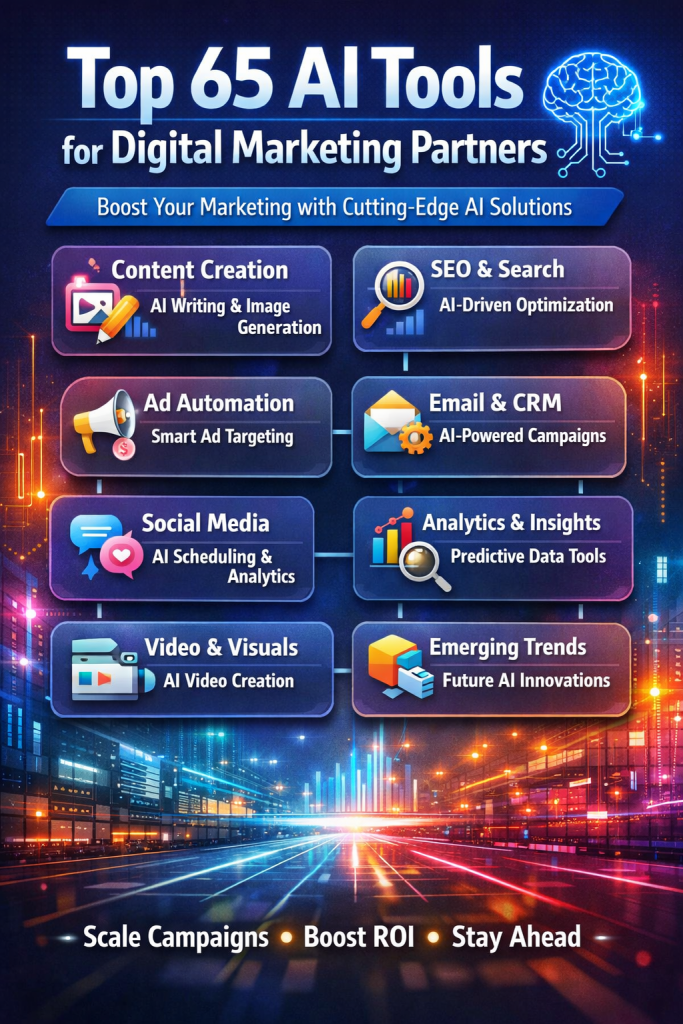
Artificial intelligence (AI) has become a cornerstone of modern digital marketing — transforming how campaigns are planned, executed, optimized, and measured. From automated content creation and advanced SEO analysis to predictive customer analytics, AI tools empower marketers to do more with less, increase efficiency, and deliver measurable ROI. While there are hundreds of solutions, this list highlights 70+ AI-driven tools digital marketing partners can leverage in 2026 to scale performance and gain a competitive edge.
1. AI Tools for Content Creation & Writing (Detailed Guide)
In 2026, content remains the foundation of digital marketing — but the speed, personalization, and scale required today are impossible without AI support. Whether you are a freelancer, agency partner, affiliate marketer, or brand strategist, AI writing tools help you:
- Produce high-quality blogs consistently
- Maintain brand tone and messaging
- Optimize for SEO automatically
- Repurpose content across channels
- Reduce production time and cost
Below is a deeper look at the top AI tools transforming content creation.
1. ChatGPT (OpenAI) – Generative Text & Strategic Content
ChatGPT is one of the most versatile AI writing assistants available. It goes beyond simple copy generation and helps with:
- Blog outlines and long-form articles
- Ad copy and email sequences
- SEO content clustering
- Keyword integration strategies
- Content repurposing
- Script writing for YouTube & podcasts
- Marketing strategy brainstorming
For digital marketing partners, ChatGPT is especially powerful for:
- Creating scalable content frameworks
- Developing content calendars
- Personalizing messaging for different audiences
- Research summarization
It works best when guided with clear prompts and brand guidelines.
2. Jasper AI – Marketing & Sales Copy Specialist
Jasper AI is designed specifically for marketers and copywriters. It excels at:
- High-converting sales copy
- Landing page content
- Facebook & Google ad creatives
- Product descriptions
- Email campaigns
Key strengths:
- Brand voice memory
- Pre-built marketing templates
- Campaign-based content workflows
Jasper is ideal for agencies managing multiple clients who need consistent tone and structured marketing outputs.
3. Copy.ai – Fast & Conversion-Oriented Copywriting
Copy.ai focuses on quick, creative copy generation. It is popular for:
- Short-form ad copy
- Website headlines
- Social media captions
- Sales email variations
- Funnel messaging
Digital marketers use it to:
- Generate multiple variations for A/B testing
- Create high-impact CTAs
- Develop product positioning angles
It is particularly helpful for performance marketers running paid campaigns.
4. Koala Writer – SEO-Focused Blog Creation
Koala Writer specializes in search-optimized long-form content. It integrates:
- Real-time SERP analysis
- Structured SEO headings
- Keyword optimization
- Readability improvements
This tool is especially useful for:
- Affiliate marketers
- Niche bloggers
- SEO agencies
- Content publishers
Koala Writer helps create content aligned with ranking opportunities rather than just generating text.
5. Article Forge – Automated Long-Form Article Generation
Article Forge focuses on producing complete articles automatically. It is designed for:
- Bulk content creation
- Niche websites
- Affiliate blogs
- Content scaling strategies
While it may require human editing for tone refinement, it significantly reduces production time for large content volumes.
6. Narrato – Collaboration + AI Content Workflow
Narrato combines AI generation with team collaboration features. It supports:
- Content briefs
- Workflow management
- AI-assisted drafting
- Editorial reviews
- Team feedback integration
It is ideal for:
- Content agencies
- Multi-writer teams
- Structured editorial planning
Narrato bridges AI writing with project management.
7. Simplified – Content + Graphic Creation in One Platform
Simplified integrates writing, design, and social publishing in one dashboard. Features include:
- AI copy generation
- Social post templates
- Graphic design tools
- Content scheduling
This makes it suitable for:
- Small businesses
- Social media managers
- Entrepreneurs handling multiple tasks
It reduces tool fragmentation by combining creative functions.
8. WriteSonic – Multichannel AI Writing Tool
WriteSonic supports content across channels:
- Blogs
- Ads
- Product descriptions
- Emails
- Website content
It also includes SEO optimization and AI chat capabilities. Marketing teams use it for omnichannel consistency.
9. INK Editor – AI Writing + SEO Scoring
INK Editor blends writing assistance with SEO performance scoring. It helps:
- Improve readability
- Optimize keyword density
- Enhance content structure
- Improve ranking potential
For SEO professionals, INK provides real-time feedback before publishing.
10. Rytr – Budget-Friendly AI Writing Assistant
Rytr is a cost-effective AI writing solution suitable for:
- Freelancers
- Startups
- Early-stage bloggers
It offers:
- Multiple writing tones
- Short-form content generation
- Idea expansion
- Simple interface
While not as advanced as enterprise tools, it is accessible and practical for beginners.
Why AI Writing Tools Matter for Digital Marketing Partners
AI does not replace strategy — it enhances execution. When used properly, these tools help:
✔ Increase content production speed
✔ Improve SEO optimization
✔ Personalize messaging at scale
✔ Reduce content costs
✔ Test multiple marketing angles quickly
However, successful marketers always:
- Edit AI outputs manually
- Add human insight and originality
- Ensure factual accuracy
- Maintain authentic brand voice
AI writing tools are now essential infrastructure for digital marketing partners. The key is not choosing just one tool — but selecting the right combination based on:
- Budget
- Content volume
- SEO goals
- Team size
- Campaign objectives
Used strategically, these platforms transform content from a manual burden into a scalable growth engine.
2. Editing, Grammar & Language Enhancement (Detailed Guide)
Creating content is only half the job — refining it is what builds authority. In digital marketing, credibility depends on clarity, precision, and professionalism. Even a small grammar mistake can reduce trust, especially in industries like finance, SaaS, legal, or consulting.
AI-powered editing tools help marketers:
- Improve grammar and sentence structure
- Enhance tone and clarity
- Adjust writing for different audiences
- Increase readability
- Maintain brand voice consistency
- Polish persuasive messaging
Below is a deeper look at leading AI editing and language enhancement tools.
1. Grammarly – AI Proofreading & Tone Detection
Grammarly is one of the most widely used AI editing tools globally. It offers:
- Grammar correction
- Spelling and punctuation fixes
- Tone analysis (formal, confident, friendly, etc.)
- Clarity suggestions
- Engagement improvement recommendations
- Plagiarism detection (premium)
For digital marketing partners, Grammarly is especially useful for:
- Client proposals
- Website copy
- Email campaigns
- Press releases
- LinkedIn content
Its tone detection feature is valuable when communicating with different audiences — such as corporate clients vs. retail customers.
Best For: Professionals who want quick, reliable proofreading integrated into browsers, email platforms, and content management systems.
2. Hemingway Editor – Clarity & Readability Optimization
Hemingway Editor focuses on making writing bold, simple, and clear. It highlights:
- Long or complex sentences
- Passive voice
- Excessive adverbs
- Hard-to-read paragraphs
- Readability grade level
In digital marketing, simplicity often increases conversions. Clear copy:
- Improves landing page performance
- Enhances user engagement
- Reduces bounce rates
- Makes technical topics more accessible
Hemingway is ideal for:
- Blog writers
- Sales copy editors
- Technical writers simplifying content
- Agencies optimizing UX content
Best For: Writers aiming for clean, persuasive, and easy-to-understand communication.
3. QuillBot – Paraphrasing & Grammar AI
QuillBot specializes in paraphrasing and rewriting content while maintaining meaning. Features include:
- Multiple rewriting modes (formal, simple, creative, etc.)
- Grammar checking
- Sentence restructuring
- Summarization tool
- Citation generator
Digital marketers use QuillBot to:
- Repurpose content for multiple platforms
- Rewrite articles for different audience segments
- Improve sentence flow
- Avoid repetitive phrasing
It is particularly helpful for affiliate marketers and bloggers creating multiple versions of similar content.
Best For: Content repurposing and rewriting with improved clarity.
4. Wordtune – Engagement-Focused Rewriting
Wordtune goes beyond grammar correction by offering intelligent rewriting suggestions. It helps with:
- Sentence rephrasing
- Tone adjustments
- Expanding short ideas
- Shortening lengthy explanations
- Making text more conversational
Marketing teams often use Wordtune to:
- Improve email open rates
- Make ad copy more compelling
- Adjust tone for social media
- Refine thought leadership content
It is useful when you want to enhance persuasion without rewriting everything manually.
Best For: Improving engagement and conversational flow.
5. ProWritingAid – Deep Writing Analysis
ProWritingAid provides comprehensive writing reports, including:
- Grammar and style suggestions
- Repetition detection
- Consistency checks
- Structure analysis
- Overused word tracking
- In-depth readability metrics
Unlike lighter editing tools, ProWritingAid offers detailed diagnostics — making it useful for:
- Long-form blog content
- eBooks
- Reports
- Academic-style articles
- Technical whitepapers
It’s particularly beneficial for serious writers and agencies focused on premium-quality content.
Best For: Deep editing and long-form content refinement.
Why Editing Tools Matter for Digital Marketing
Polished writing leads to:
✔ Higher credibility
✔ Stronger brand perception
✔ Better conversion rates
✔ Improved SEO performance
✔ Enhanced reader retention
For financial, consulting, or professional services websites — clarity and accuracy are especially critical.
Pro Tip for Digital Marketing Partners
The most effective workflow often combines tools:
- Generate content using AI writing platforms.
- Run it through Grammarly for grammar and tone.
- Use Hemingway to simplify structure.
- Refine persuasion with Wordtune.
- Perform deep quality checks with ProWritingAid (for premium content).
AI editing tools do not replace human judgment — they enhance it. Strategic marketers use them as refinement engines, ensuring every piece of content:
- Is clear
- Is persuasive
- Reflects professionalism
- Aligns with brand voice
In a competitive digital landscape, clean and compelling writing is not optional — it is a strategic advantage.
3. AI SEO & Search Optimization (Detailed Guide)
Search Engine Optimization has evolved far beyond inserting keywords into content. Modern SEO focuses on:
- Search intent
- Semantic relevance
- Topic authority
- User engagement signals
- Competitive intelligence
- Predictive ranking analysis
AI-powered SEO tools now analyze massive datasets to help marketers understand why content ranks — and how to outperform competitors.
For digital marketing partners, AI SEO tools provide:
✔ Data-driven keyword strategies
✔ Competitive content gap analysis
✔ On-page optimization guidance
✔ Backlink intelligence
✔ Technical SEO auditing
✔ Predictive traffic insights
Below is a detailed breakdown of leading AI-powered SEO platforms.
1. Semrush (with AI Visibility & Content Intelligence)
Semrush is one of the most comprehensive SEO platforms globally. Its AI-driven features help marketers:
- Identify high-value keywords
- Analyze competitor strategies
- Track SERP volatility
- Discover content gaps
- Optimize topic clusters
- Monitor brand visibility
AI Visibility tools allow you to measure how your brand performs across search ecosystems — including emerging AI-powered search results.
For digital marketing agencies, Semrush is powerful for:
- Client reporting dashboards
- Keyword intent analysis
- Paid + organic campaign integration
- Market research
Best For: Full-scale SEO campaigns and competitive intelligence.
2. Surfer SEO – AI-Driven On-Page Optimization
Surfer SEO focuses heavily on content optimization. It uses AI and SERP analysis to provide:
- Ideal word count suggestions
- Keyword frequency recommendations
- Semantic keyword inclusion
- NLP-based optimization
- Content structure improvements
It analyzes top-ranking pages and gives real-time optimization scores as you write.
For content marketers, Surfer helps:
- Increase ranking probability
- Improve content relevance
- Optimize blog articles
- Align with search intent
Best For: On-page SEO and blog optimization.
3. Frase – AI Content Briefs & Optimization
Frase combines AI writing assistance with SEO research. Key features include:
- Automated content briefs
- Competitor summary analysis
- Question-based keyword extraction
- AI-generated draft assistance
- SERP-driven optimization suggestions
Frase is particularly useful for:
- Creating structured blog outlines
- Building authority content
- Answering search intent queries
- Targeting featured snippets
It helps content teams move from research to publishing much faster.
Best For: Structured SEO content planning and brief generation.
4. Ahrefs AI Tools – Keyword & Backlink Intelligence
Ahrefs is known for its powerful backlink database and keyword analysis tools. With AI-driven insights, it offers:
- Keyword difficulty scoring
- Traffic potential analysis
- Content gap identification
- Competitor backlink tracking
- SERP movement monitoring
Backlinks remain a major ranking factor, and Ahrefs helps digital marketers:
- Identify link-building opportunities
- Analyze referring domains
- Monitor lost and gained links
- Evaluate domain authority
Best For: Backlink analysis and competitive SEO strategy.
5. Clearscope – Search-Driven Content Optimization
Clearscope uses AI to enhance semantic SEO. It provides:
- Content grading system
- NLP-based keyword suggestions
- Search relevance scoring
- Competitor analysis
Unlike basic keyword tools, Clearscope emphasizes topical authority. It helps ensure content:
- Matches search intent
- Covers subtopics thoroughly
- Ranks for related search variations
For agencies managing finance, SaaS, or authority blogs, Clearscope ensures high-quality, search-aligned writing.
Best For: High-quality, authoritative content optimization.
6. Moz Pro AI – Machine Learning SEO Toolkit
Moz Pro integrates machine learning into traditional SEO analysis. It offers:
- Keyword research
- Domain authority tracking
- SERP analysis
- Technical SEO audits
- Rank tracking
Moz’s AI enhancements help identify:
- Ranking opportunities
- Site crawl errors
- Link equity distribution
- Optimization improvements
It remains popular among agencies and small-to-mid-sized businesses.
Best For: Technical SEO and domain performance monitoring.
Why AI SEO Matters Today
Search engines now use advanced algorithms that analyze:
- Context
- User behavior
- Content quality
- Topical depth
- Authority signals
AI SEO tools help marketers align with these ranking factors by providing data-backed recommendations instead of guesswork.
Pro Strategy for Digital Marketing Partners
A powerful workflow might look like:
- Use Semrush or Ahrefs for keyword research and competitor analysis.
- Build content briefs with Frase.
- Optimize drafts using Surfer SEO or Clearscope.
- Monitor rankings and backlinks continuously.
This layered approach improves both on-page and off-page SEO performance.
AI-driven SEO is no longer optional — it is essential.
Digital marketing partners who leverage intelligent optimization tools gain:
- Faster ranking improvements
- Better content alignment with search intent
- Data-driven competitive advantage
- Higher organic traffic stability
SEO success today depends on combining strategy, data, and AI precision — not just keywords.
4. AI for Advertising & Campaign Optimization
Digital advertising has become increasingly complex. Brands must manage:
- Multiple platforms (Google, Meta, TikTok, LinkedIn, X)
- Multiple formats (video, display, carousel, search, shopping)
- Real-time performance optimization
- Creative testing at scale
- Budget allocation decisions
- Audience segmentation refinement
AI-powered advertising tools help marketers move from manual campaign management to automated, data-driven optimization.
For digital marketing partners and agencies, these tools enable:
✔ Faster creative production
✔ Automated A/B testing
✔ Budget optimization
✔ Audience-level personalization
✔ Higher ROAS (Return on Ad Spend)
✔ Cross-platform campaign scaling
Below is a detailed breakdown of leading AI advertising platforms.
1. AdCreative.ai – AI-Generated Ad Creatives
AdCreative.ai focuses on generating high-converting ad creatives using AI and performance data.
Key features:
- AI-generated ad banners
- Social media creatives
- Conversion-focused design templates
- Data-backed creative scoring
- Creative variations for A/B testing
Instead of manually designing dozens of ad variations, marketers can generate multiple creatives optimized for different audience segments.
Best For: Agencies and e-commerce brands needing rapid creative scaling.
2. Omneky – Personalized Ad Generation at Scale
Omneky combines generative AI with performance data to create personalized ad variations.
Core capabilities:
- Dynamic ad generation
- Creative personalization
- Data-driven optimization
- Performance-based creative refinement
- Multi-platform campaign support
Omneky analyzes which creatives perform best and automatically adjusts messaging, visuals, and calls-to-action.
Best For: Performance marketers running high-volume campaigns.
3. Smartly.io – End-to-End Paid Social Automation
Smartly.io is a powerful enterprise-level advertising automation platform.
It supports:
- Meta Ads
- TikTok
- Snapchat
- Google Display
- Programmatic campaigns
AI-powered features include:
- Budget allocation optimization
- Dynamic creative optimization
- Automated audience targeting
- Real-time performance tracking
- Cross-channel insights
It centralizes campaign management and reduces manual workload.
Best For: Large agencies and global brands managing high ad spend.
4. Celtra – Creative Management & Automation
Celtra specializes in creative automation and production scaling.
Capabilities:
- Dynamic ad personalization
- Creative asset management
- Template-based ad production
- Cross-channel creative deployment
- Workflow collaboration tools
Celtra helps brands maintain consistent branding while producing thousands of variations for different audience segments.
Best For: Brands running global multi-channel campaigns.
5. Phrasee – AI-Powered Copy Optimization
Phrasee focuses on optimizing ad and email copy using natural language generation and predictive analytics.
It helps improve:
- Subject lines
- Ad headlines
- Push notification copy
- Social media captions
- Email campaigns
AI tests language variations and predicts which tone and wording will drive higher engagement.
Best For: Brands focused on conversion rate optimization (CRO).
6. Adzooma – AI Recommendations for PPC Campaigns
Adzooma simplifies paid advertising management for:
- Google Ads
- Facebook Ads
- Microsoft Ads
It offers:
- AI-based performance recommendations
- Budget optimization alerts
- Keyword improvement suggestions
- Campaign health scoring
- Automated reporting dashboards
Adzooma is ideal for small-to-mid-sized businesses needing actionable PPC insights without complex enterprise software.
Best For: SMBs and growing agencies managing PPC accounts.
7. MoAI – AI-Powered Ad Suite for Brands
MoAI provides intelligent campaign management tools designed to:
- Analyze audience behavior
- Predict performance trends
- Optimize ad placements
- Improve creative targeting
- Scale campaigns efficiently
It focuses on maximizing campaign ROI using AI-driven optimization and automation.
Best For: Data-driven brands looking to improve paid media efficiency.
Why AI in Advertising Matters Today
Digital advertising is no longer about launching campaigns and waiting for results. AI enables:
- Real-time optimization
- Predictive performance analysis
- Automated creative testing
- Smart budget reallocation
- Audience-level personalization
AI-driven systems analyze thousands of data points faster than any manual team can.
Pro Strategy for Digital Marketing Partners
A strong advertising workflow may include:
- Generate creatives with AdCreative.ai or Omneky.
- Deploy campaigns using Smartly.io or Celtra.
- Optimize messaging using Phrasee.
- Monitor PPC performance with Adzooma.
- Continuously refine targeting based on AI insights.
This layered system increases:
- Conversion rates
- Click-through rates
- Engagement levels
- Return on ad spend
AI advertising tools do not replace marketers — they amplify them.
The most successful digital marketing partners use AI to:
- Reduce creative production time
- Improve campaign precision
- Scale performance campaigns faster
- Increase measurable ROI
In today’s competitive digital ecosystem, intelligent automation is no longer optional — it is a competitive advantage.
5. Visual & Graphic AI Tools
In digital marketing, visual content is no longer optional — it is essential. Social media algorithms prioritize engaging visuals, landing pages convert better with graphics, and video dominates audience attention across platforms.
AI-powered visual tools dramatically reduce:
- Design time
- Production costs
- Editing complexity
- Creative bottlenecks
For digital marketing partners, these tools enable rapid content production at scale while maintaining quality and brand consistency.
Below is a detailed breakdown of leading AI-powered visual and multimedia platforms.
1. DALL·E – AI Image Generation from Text Prompts
DALL·E generates custom images based on descriptive text prompts.
Key capabilities:
- Create unique marketing visuals
- Generate product mockups
- Produce conceptual illustrations
- Edit images using inpainting
- Remove or modify image elements
Instead of searching stock libraries, marketers can generate custom visuals tailored to specific campaigns.
Best For: Custom blog illustrations, ad creatives, and conceptual product imagery.
2. Midjourney – Advanced Artistic AI Visuals
Midjourney is known for highly detailed, artistic image generation.
It excels in:
- Brand storytelling visuals
- Creative ad backgrounds
- High-impact social media graphics
- Stylized promotional artwork
- Concept branding visuals
Its artistic strength makes it popular among designers and creative agencies.
Best For: Premium brand visuals and visually distinctive campaigns.
3. Stable Diffusion – Open-Source Image Generation
Stable Diffusion is an open-source AI image generation model.
Advantages:
- Customizable workflows
- Advanced image control
- Fine-tuned brand-specific styles
- Local deployment options
- Developer flexibility
Agencies can integrate Stable Diffusion into internal tools for scalable creative production.
Best For: Developers and agencies wanting custom AI creative systems.
4. Images.ai – Template-Based Image Creation
Images.ai simplifies AI-generated visuals using structured templates.
Features:
- Marketing banners
- Social media posts
- E-commerce product ads
- Ready-made creative layouts
- Quick design automation
This reduces the need for advanced design skills.
Best For: Small businesses and solo marketers needing quick ad creatives.
5. Clipdrop – AI Background Removal & Image Editing
Clipdrop specializes in smart editing.
Core features:
- Background removal
- Object cleanup
- Relighting
- Image enhancement
- Upscaling low-resolution images
It helps create clean product images and professional ad creatives quickly.
Best For: E-commerce brands and product marketers.
6. PhotoRoom – AI Background Replacement
PhotoRoom focuses on:
- Professional product photography
- Background replacement
- Shadow and lighting effects
- Marketplace-ready product visuals
- Social media creatives
Perfect for Amazon, Shopify, and marketplace sellers.
Best For: Online sellers and dropshipping businesses.
7. Canva AI – Graphic Design with Generative Features
Canva integrates AI into an easy-to-use design platform.
AI features include:
- Magic Design (auto layout suggestions)
- AI text-to-image
- Background remover
- AI writing assistant
- Brand kit integration
Canva allows teams to collaborate while maintaining brand consistency.
Best For: Social media managers and small-to-medium marketing teams.
8. Descript – AI Video & Audio Editing
Descript transforms video editing by allowing users to edit video like text.
Features:
- AI transcription
- Voice cloning (Overdub)
- Remove filler words automatically
- Screen recording
- Podcast editing
- Multi-track editing
This dramatically simplifies podcast and video production.
Best For: Content creators, podcasters, and YouTube marketers.
9. InVideo – AI-Assisted Video Creation
InVideo enables fast video production using AI scripts and templates.
Capabilities:
- Text-to-video conversion
- Pre-designed video templates
- Social media video ads
- Automated voiceovers
- Stock media integration
It helps marketers convert blog content into short-form videos.
Best For: Social media video ads and promotional content.
10. Pictory – AI Video Maker for Social Content
Pictory specializes in turning long-form content into short social videos.
Features:
- Blog-to-video conversion
- Script-to-video generation
- Automated captions
- Highlight extraction
- Branded video creation
It is particularly useful for repurposing content across platforms.
Best For: Content repurposing and short-form marketing videos.
Why Visual AI Matters for Digital Marketing Partners
Modern audiences consume:
- Short-form video
- Visual storytelling
- Product-driven imagery
- Interactive content
- Branded social graphics
AI reduces the cost and time barrier to producing high-quality content.
Benefits include: ✔ Faster campaign launches
✔ Lower design dependency
✔ Scalable creative testing
✔ Higher engagement rates
✔ Better visual personalization
Pro Strategy for Agencies
A powerful workflow could look like:
- Generate hero visuals using Midjourney or DALL·E
- Edit product images with Clipdrop or PhotoRoom
- Design campaign graphics in Canva AI
- Convert blogs into video using Pictory
- Edit podcast/video content in Descript
- Launch video ads using InVideo
This integrated system enables content multiplication across platforms.
Visual AI tools are transforming digital marketing from design-heavy workflows into scalable creative ecosystems.
The brands and agencies that combine:
- AI image generation
- Automated editing
- Rapid video production
- Cross-platform content repurposing
will outperform competitors in both speed and engagement.
In the AI era, visual content is not just about creativity — it is about intelligent, scalable production.
6. Social Media & Community Tools
In today’s digital ecosystem, social media is not just a distribution channel — it is a primary engine for brand visibility, engagement, and conversion. However, managing multiple platforms, publishing consistently, analyzing engagement, and responding to communities can quickly become overwhelming.
AI-powered social media tools help marketing teams:
- Automate scheduling
- Optimize posting times
- Analyze audience behavior
- Monitor brand sentiment
- Generate content ideas
- Curate user-generated content (UGC)
- Improve engagement strategy
For digital marketing partners, these tools transform social media from reactive posting into data-driven community growth.
Below is a detailed breakdown of leading AI-driven social media and community management platforms.
1. Hootsuite AI Tools – Scheduling + Sentiment Analytics
Hootsuite is one of the most established social media management platforms, and its AI capabilities enhance strategic planning.
AI-powered features include:
- Optimal posting time recommendations
- Automated content suggestions
- Sentiment analysis across social mentions
- AI caption generation
- Engagement tracking dashboards
- Competitor benchmarking
Hootsuite’s sentiment analytics helps brands understand whether conversations around them are positive, neutral, or negative — critical for reputation management.
Best For: Agencies managing multiple client accounts and requiring advanced monitoring.
2. Buffer – Content Planner with AI Suggestions
Buffer focuses on simplicity and usability while integrating AI-powered enhancements.
Key capabilities:
- Post scheduling across major platforms
- AI-generated caption suggestions
- Performance analytics
- Audience engagement tracking
- Link-in-bio optimization
Buffer’s AI tools help refine copy, improve clarity, and suggest optimized posting times.
Best For: Small businesses, startups, and solo digital marketers.
3. Loomly – Social Content Calendar & AI Post Ideas
Loomly is built around collaborative content planning.
AI-driven features:
- Automated post ideas based on trends
- Platform-specific optimization suggestions
- Hashtag recommendations
- Approval workflows
- Real-time post previews
Loomly simplifies editorial calendar management for teams while helping maintain consistent publishing.
Best For: Marketing teams needing structured workflow and collaborative planning.
4. Sprout Social AI – Engagement Analytics & Trend Insights
Sprout Social is known for powerful analytics and enterprise-grade reporting.
AI capabilities include:
- Advanced social listening
- Audience sentiment tracking
- Predictive trend identification
- Performance benchmarking
- Automated reporting
- Influencer identification
Sprout Social helps brands identify trending topics early, enabling proactive engagement strategies.
Best For: Large brands and enterprises prioritizing analytics-driven strategy.
5. Later – Visual Social Planner with AI Optimization
Later is especially popular for Instagram-focused marketing.
Core AI features:
- Visual content calendar
- Best-time-to-post suggestions
- Hashtag analytics
- Link-in-bio monetization tools
- Instagram feed preview
Its visual-first approach makes it ideal for brands where aesthetics drive engagement.
Best For: Instagram brands, influencers, fashion and lifestyle businesses.
6. Taggbox – Curated UGC with AI Filtering
User-generated content (UGC) is one of the most powerful trust-building tools in marketing.
Taggbox uses AI to:
- Curate content from social platforms
- Filter inappropriate or irrelevant posts
- Analyze engagement metrics
- Embed live social feeds on websites
- Moderate brand mentions
UGC improves authenticity, and Taggbox ensures only high-quality content is displayed.
Best For: Brands leveraging customer reviews and social proof.
Why AI in Social Media Matters
Social platforms are constantly evolving. Algorithms reward:
- Consistent posting
- High engagement
- Relevant content
- Timely interaction
AI enhances social media marketing by:
✔ Identifying optimal posting times
✔ Analyzing sentiment in real time
✔ Suggesting content improvements
✔ Tracking competitor performance
✔ Detecting emerging trends
✔ Scaling content across platforms
Without AI, managing multiple channels can become inefficient and inconsistent.
Strategic Workflow for Digital Marketing Partners
An effective AI-driven workflow might look like:
- Use Loomly to plan monthly content calendar
- Generate captions via Buffer AI
- Schedule and monitor through Hootsuite
- Track analytics and trends using Sprout Social
- Optimize Instagram visuals via Later
- Showcase user-generated content using Taggbox
This integrated system improves both content quality and community engagement.
Pro Tips for Social Media Success
- Don’t rely solely on automation — maintain authentic human interaction
- Monitor sentiment regularly to protect brand reputation
- Use analytics to refine strategy monthly
- Test different posting times and content formats
- Repurpose high-performing posts into ads
- Encourage UGC to increase trust and credibility
AI-powered social media tools transform reactive posting into strategic engagement management.
The brands and agencies that combine:
- Smart scheduling
- Data-driven insights
- Real-time sentiment monitoring
- Community building
- Content optimization
will achieve stronger brand loyalty, higher engagement rates, and better ROI in digital campaigns.
In modern marketing, social media is not just about posting — it is about intelligent, measurable, and scalable community growth.
7. Email & CRM AI Assistants
Email marketing and CRM systems are no longer just databases or newsletter tools — they are intelligent relationship engines. With AI integration, modern platforms can predict behavior, personalize communication, automate nurturing journeys, and increase conversion rates at scale.
For digital marketing partners, Email + CRM AI tools help:
- Automate complex workflows
- Personalize communication at scale
- Improve open and click-through rates
- Predict customer behavior
- Identify high-value leads
- Increase lifetime customer value (LTV)
- Reduce churn
Below is a deeper look at leading AI-powered email and CRM platforms.
1. HubSpot AI – CRM + Marketing Automation Intelligence
HubSpot combines CRM, marketing automation, sales enablement, and customer service tools into one ecosystem — now enhanced with AI capabilities.
AI Features:
- Predictive lead scoring
- Automated workflow creation
- Smart content personalization
- AI email subject line suggestions
- Chatbot automation
- Deal forecasting insights
- Behavioral segmentation
HubSpot AI helps businesses understand which leads are most likely to convert and automatically trigger the right communication at the right time.
Best For: Growing businesses and agencies managing inbound marketing funnels.
2. Salesforce Einstein – Predictive AI for Enterprise CRM
Salesforce Einstein integrates AI directly into the Salesforce CRM ecosystem, offering enterprise-grade predictive analytics.
Key AI Capabilities:
- Predictive opportunity scoring
- Revenue forecasting
- AI-powered next-best-action suggestions
- Customer churn prediction
- Automated email insights
- Intelligent lead routing
Einstein analyzes large datasets to identify patterns that humans might miss, helping sales teams prioritize high-probability deals.
Best For: Large enterprises with complex sales cycles and high-volume customer data.
3. Mailchimp AI – Smart Segmentation & Content Optimization
Mailchimp integrates AI into email campaign design and audience targeting.
AI-Powered Features:
- Audience segmentation based on behavior
- Predictive demographics
- Send-time optimization
- AI subject line suggestions
- Content scoring
- Automated customer journeys
Mailchimp’s AI helps marketers refine messaging and improve open rates through data-driven personalization.
Best For: Small to mid-sized businesses and eCommerce brands.
4. Seventh Sense – AI Email Timing Optimization
Seventh Sense specializes in optimizing when emails are delivered.
AI Focus:
- Individual-level send-time optimization
- Engagement pattern tracking
- Behavioral email scheduling
- Improved deliverability metrics
Instead of sending emails at a fixed time, Seventh Sense analyzes user engagement behavior and delivers messages when recipients are most likely to open.
Even small timing improvements can significantly increase engagement rates.
Best For: High-volume email marketers using HubSpot or Marketo.
5. ActiveCampaign – AI-Driven Automation & Forecasting
ActiveCampaign blends CRM, automation, and email marketing into a powerful AI-enhanced platform.
AI Capabilities:
- Predictive sending
- Conditional automation sequences
- Lead scoring
- Customer lifecycle forecasting
- Dynamic content personalization
- Purchase probability prediction
Its automation builder allows highly customized workflows based on behavior triggers.
Best For: eCommerce, SaaS, and service businesses focused on lifecycle marketing.
6. SharpSpring AI – Predictive Lead Scoring
SharpSpring (now part of Constant Contact’s marketing suite) integrates AI for marketing automation and lead intelligence.
AI Highlights:
- Predictive lead scoring
- Automated sales alerts
- Behavioral tracking
- CRM integration
- Funnel analytics
The platform helps sales teams focus on the most engaged prospects instead of cold leads.
Best For: Agencies and mid-sized B2B companies.
Why AI in Email & CRM Matters
Traditional email marketing relies on:
- Batch campaigns
- Static segmentation
- Manual analysis
AI transforms this into:
✔ Behavior-based segmentation
✔ Predictive lead prioritization
✔ Smart send-time optimization
✔ Automated lifecycle journeys
✔ Data-driven personalization
✔ Revenue forecasting
The result? Higher engagement, better conversion rates, and improved ROI.
Practical Workflow for Digital Marketing Partners
A smart AI-driven CRM workflow may look like:
- Capture leads through website forms
- Use AI lead scoring (HubSpot / Salesforce)
- Segment audience automatically (Mailchimp AI)
- Optimize send timing (Seventh Sense)
- Trigger automated nurturing flows (ActiveCampaign)
- Alert sales team when conversion probability increases
This creates a seamless marketing-to-sales pipeline.
Pro Tips for Email & CRM Success
- Avoid over-automation — maintain authentic communication
- Regularly clean your email lists
- Use predictive scoring to prioritize outreach
- Test AI-generated subject lines
- Monitor deliverability metrics
- Align CRM data with marketing analytics
- Personalize beyond first names — use behavioral insights
Strategic Insight
In 2026 and beyond, relationship marketing is data-driven.
The most successful brands do not send generic emails — they deliver personalized experiences powered by AI insights.
AI-enabled CRM systems allow businesses to:
- Understand customer intent
- Anticipate buying behavior
- Automate nurturing
- Reduce manual workload
- Improve retention
For digital marketing partners, Email & CRM AI assistants are no longer optional — they are foundational tools for scalable, intelligent growth.
8. Analytics, Insights & Predictive Tools
In modern digital marketing, data is not just reporting — it is strategy.
The difference between average campaigns and high-performing growth engines often lies in how intelligently businesses interpret and act on data.
AI-powered analytics tools go beyond dashboards. They help predict behavior, identify opportunities, personalize targeting, and forecast outcomes before they happen.
For digital marketing partners, analytics AI tools enable:
- Predictive revenue modeling
- Customer behavior forecasting
- Audience segmentation
- Funnel optimization
- Real-time performance insights
- Data-backed decision-making
Below is a deeper breakdown of leading AI-driven analytics platforms.
1. Google Analytics 4 (GA4) with AI – Predictive Customer Insights
Google Analytics 4 integrates machine learning to move beyond traditional traffic tracking.
AI Capabilities:
- Predictive purchase probability
- Churn probability modeling
- Revenue forecasting
- Cross-device tracking
- Event-based behavior analysis
- Automated anomaly detection
Unlike Universal Analytics, GA4 uses event-based tracking rather than session-based data, allowing deeper behavioral insights.
Why It Matters:
- Identifies high-intent users
- Predicts which audiences are likely to convert
- Helps optimize retargeting campaigns
- Improves ad spend efficiency
Best For: Businesses wanting predictive insights without enterprise-level cost.
2. Tableau AI – Advanced Data Visualization & Forecasting
Tableau integrates AI and machine learning into business intelligence dashboards.
AI Features:
- Predictive trend analysis
- Automated data pattern detection
- Scenario forecasting
- Smart recommendations
- Natural language queries (“Ask Data” functionality)
Tableau helps transform complex datasets into intuitive visual stories that executives and marketers can understand quickly.
Use Cases:
- Campaign performance forecasting
- Revenue trend analysis
- Customer acquisition cost modeling
- Multi-channel attribution analysis
Best For: Large businesses and data-driven marketing teams.
3. Delve.ai – AI-Generated Audience Personas
Delve.ai specializes in automatically creating audience personas based on website and customer data.
AI Capabilities:
- Behavioral persona generation
- Demographic analysis
- Content personalization insights
- Competitor persona modeling
- Virtual persona simulations
Instead of manually creating marketing personas, Delve.ai uses real user data to build realistic audience segments.
Why It’s Powerful:
- Reduces guesswork
- Improves targeting accuracy
- Enhances content personalization
- Supports ad optimization
Best For: Businesses looking to refine targeting and messaging.
4. Creator CRM AI – Audience Segmentation & Targeting
Creator CRM AI platforms help brands and influencers manage audience engagement using predictive data.
AI Features:
- Smart segmentation
- Engagement scoring
- Predictive conversion modeling
- Automated outreach personalization
- Campaign performance tracking
This tool is particularly useful for influencer marketing and community-driven brands.
Strategic Benefit:
- Identify high-engagement followers
- Improve sponsorship targeting
- Increase collaboration ROI
Best For: Influencer agencies and content-driven brands.
5. Tidio AI – Chatbot Analytics & Customer Insights
Tidio combines AI chatbots with analytics insights to improve customer experience.
AI Capabilities:
- Automated customer support
- Conversation sentiment analysis
- Behavior-triggered chat engagement
- Lead qualification automation
- Customer satisfaction insights
AI chatbots are no longer basic responders — they gather actionable data.
Benefits:
- 24/7 engagement
- Reduced support costs
- Lead capture automation
- Real-time user intent detection
Best For: eCommerce, SaaS, and service-based websites.
Why AI Analytics Is a Game Changer
Traditional analytics answers:
“What happened?”
AI analytics answers:
“What will likely happen next?”
That predictive layer transforms marketing strategy from reactive to proactive.
Practical Use Case Example
Imagine this workflow:
- GA4 predicts high purchase probability users
- Delve.ai refines persona segments
- Creator CRM targets high-engagement communities
- Tidio chatbot captures real-time queries
- Tableau visualizes overall campaign performance
This creates an integrated, data-driven ecosystem.
Key Benefits of AI-Powered Analytics
✔ Faster decision-making
✔ Reduced guesswork
✔ Improved ad targeting
✔ Higher ROI on campaigns
✔ Predictive growth modeling
✔ Better customer understanding
✔ Early detection of performance drops
Pro Tips for Digital Marketing Partners
- Always connect analytics with CRM data
- Use predictive scores for retargeting
- Set automated alerts for anomalies
- Combine qualitative chatbot data with quantitative analytics
- Focus on conversion quality, not just traffic volume
- Review attribution models carefully
Strategic Insight for 2026 and Beyond
Data is becoming more privacy-regulated and fragmented. AI helps bridge gaps by:
- Modeling missing data
- Predicting user behavior
- Identifying trends without relying on third-party cookies
As privacy laws evolve, predictive analytics will become even more critical.
Analytics, insights, and predictive tools are the backbone of intelligent digital marketing.
Businesses that leverage AI-driven data tools:
- Scale faster
- Spend smarter
- Convert better
- Reduce risk
In today’s competitive environment, intuition alone is not enough — growth belongs to those who combine creativity with intelligent data systems.
9. Niche & Emerging AI Platforms (Advanced Marketing & Automation Tools)
As digital marketing matures, specialized AI tools are emerging to handle advanced workflows, automation, research synthesis, and scalable content operations. These platforms often operate behind the scenes — but they significantly improve efficiency, experimentation speed, and strategic intelligence.
For digital marketing partners, niche AI tools provide competitive advantages through automation, integration, and predictive intelligence.
1. Zapier AI – Workflow Automation & Smart Triggers
Zapier is widely known for connecting apps — but its AI capabilities now add intelligence to automation.
AI Capabilities:
- AI-generated workflow suggestions
- Smart data transformation
- Automated lead routing
- Conditional triggers
- AI summarization across apps
Why It’s Powerful:
Instead of manual repetitive tasks (like sending leads from Facebook Ads to CRM), Zapier AI automates full marketing funnels.
Best For: Agencies managing multi-platform campaigns.
2. Connexun – Custom RSS & AI Content Intelligence
Connexun helps brands monitor news and industry trends using AI-curated RSS feeds.
Key Features:
- Real-time content aggregation
- Topic filtering using NLP
- Automated content feeds
- Trend monitoring
Strategic Use:
- Stay ahead of industry developments
- Identify trending topics before competitors
- Build automated content curation systems
Best For: Media publishers and content-heavy brands.
3. Elicit – AI Research Summarization
Elicit is designed for research-driven marketers and analysts.
AI Capabilities:
- Research paper summarization
- Evidence extraction
- Automated insights
- Literature comparison
Marketing Application:
- Market research analysis
- Competitive benchmarking
- Whitepaper development
- Data-backed blog creation
Best For: Research-intensive digital marketers.
4. Narrativa – Automated Content at Scale
Narrativa focuses on AI-generated content for large-scale publishing.
Features:
- Data-driven article generation
- Automated financial reports
- Multilingual content production
- Scalable newsroom automation
Use Cases:
- E-commerce product descriptions
- Financial reporting automation
- Multi-country content scaling
Best For: Enterprises producing large volumes of structured content.
5. Airtable with AI Blocks – Data & Project Intelligence
Airtable is a hybrid between spreadsheet and database. With AI Blocks, it becomes a smart automation hub.
AI Capabilities:
- Automated data categorization
- AI-generated summaries
- Content tagging
- Predictive data insights
Marketing Benefits:
- Campaign tracking automation
- Lead scoring
- Content planning dashboards
- CRM workflow enhancement
Best For: Teams managing complex campaign pipelines.
6. Omni-Channel AI Suites (e.g., Viamedia.ai)
Omni-channel AI platforms unify advertising across channels.
AI Features:
- Cross-platform ad delivery
- Automated bid optimization
- Unified audience segmentation
- Performance forecasting
Why It Matters:
Marketers no longer need separate dashboards for TV, digital, OTT, and social ads.
Best For: Large-scale advertisers seeking centralized campaign management.
7. CopySmith – Scalable AI Content Engine
CopySmith focuses on high-volume marketing content.
Key Capabilities:
- E-commerce descriptions
- Product launch copy
- Ad variants
- Bulk content generation
Strategic Advantage:
Improves efficiency for brands with large product catalogs.
Best For: E-commerce and Amazon sellers.
8. ChatSpot.ai – AI for Inbound Marketing
ChatSpot integrates AI with CRM and inbound systems.
Features:
- CRM data insights
- Automated marketing reports
- Email drafting
- Lead tracking automation
Why It’s Useful:
It bridges conversational AI with actionable marketing analytics.
Best For: Inbound-focused businesses.
9. Fireflies – AI Meeting Transcription & CRM Sync
Fireflies captures and transcribes meetings automatically.
AI Capabilities:
- Meeting transcription
- Keyword tagging
- CRM note automation
- Conversation summaries
Marketing Benefit:
No more manual note-taking. Sales and marketing alignment improves significantly.
Best For: Sales-driven marketing teams.
10. Botify – AI SEO Crawler & Site Intelligence
Botify is an enterprise-level SEO intelligence platform.
AI Capabilities:
- Deep technical site crawling
- Log file analysis
- Crawl budget optimization
- Predictive ranking insights
Strategic Value:
Helps large websites optimize technical SEO at scale.
Best For: Large content websites and enterprises.
Why Niche AI Tools Matter
These platforms do not always generate headlines like ChatGPT — but they:
✔ Save operational time
✔ Improve workflow efficiency
✔ Enable scalable experimentation
✔ Strengthen technical SEO
✔ Enhance research depth
✔ Improve cross-platform marketing execution
In competitive digital marketing ecosystems, operational efficiency often determines profitability.
Pro Strategy for Agencies
Instead of relying on one “all-in-one” AI tool:
- Combine Zapier for automation
- Use Airtable for data structuring
- Apply Botify for SEO intelligence
- Integrate Fireflies for sales alignment
- Leverage CopySmith for content scaling
A modular AI stack often performs better than a single platform dependency.
Niche and emerging AI tools represent the next phase of marketing intelligence.
The future of digital marketing is not just content generation —
It is:
- Intelligent automation
- Predictive experimentation
- Data-driven creativity
- Integrated cross-channel orchestration
Digital marketing partners who embrace these emerging platforms will gain efficiency, scalability, and strategic advantage in the AI-driven economy.
10. Emerging Trends & Future Tools in AI for Digital Marketing Partners
The next generation of AI tools is moving beyond automation and basic content generation. We are entering an era of dynamic AI collaboration, where systems do not just execute tasks — they strategize, adapt in real time, and co-create alongside marketing teams.
For digital marketing partners, this evolution means shifting from “AI as assistant” to “AI as strategic collaborator.”
1️⃣ From Static Automation to Adaptive Intelligence
Earlier AI tools:
- Generated copy
- Scheduled posts
- Optimized keywords
Next-generation AI systems:
- Continuously learn from campaign data
- Adjust ad creatives automatically
- Shift budget allocations dynamically
- Predict performance before scaling
What’s Changing?
Instead of A/B testing manually, AI systems:
- Run multivariate tests in real time
- Detect audience fatigue
- Swap creatives automatically
- Optimize messaging by micro-segment
This creates self-improving campaigns.
2️⃣ Generative AI + Strategic Co-Creation
Future AI platforms integrate:
- Market research
- Audience insights
- Content generation
- Campaign forecasting
All in one strategic layer.
Rather than asking:
“Write a Facebook ad.”
Marketers will ask:
“Build a 3-month campaign strategy for Gen Z eCommerce targeting.”
AI will:
- Suggest positioning
- Generate content
- Estimate budget allocation
- Forecast ROI
- Recommend influencer collaborations
This transforms AI into a strategic planning engine, not just a content generator.
3️⃣ Explainable AI in Marketing Decisions
As AI grows more powerful, transparency becomes critical.
Future tools focus on:
- Explainable AI (XAI)
- Transparent performance logic
- Bias detection
- Compliance-safe targeting
Instead of black-box decisions, marketers will see:
- Why an ad was optimized
- Why budget shifted
- Why a segment underperformed
- What variables influenced conversion
This is especially important for:
- Regulated industries
- Political advertising
- Financial services
- Healthcare marketing
Explainability builds trust.
4️⃣ Real-Time Performance Adaptation
Upcoming AI tools integrate:
- Live user behavior signals
- Emotional sentiment detection
- Real-time engagement scoring
- Dynamic content replacement
Example: If engagement drops mid-campaign, AI can:
- Rewrite headlines
- Swap thumbnails
- Adjust CTA
- Retarget a new audience segment
All without manual intervention.
This creates living campaigns, not static ad sets.
5️⃣ AI-Powered Virtual Brand Ambassadors
A rapidly growing trend is AI-generated brand personas.
These include:
- AI influencers
- Virtual brand spokespeople
- Synthetic video presenters
- Interactive chatbot brand representatives
Future digital campaigns may use:
- AI brand ambassadors that speak multiple languages
- 24/7 interactive customer engagement avatars
- Hyper-personalized video messages
This enhances:
- Brand consistency
- Global scalability
- Cost efficiency
- Customer engagement
Virtual ambassadors reduce reliance on single influencer personalities while maintaining engagement.
6️⃣ AI-Driven Creative Intelligence Engines
Instead of manually designing ads, future platforms will:
- Analyze emotional triggers
- Identify high-performing design patterns
- Generate optimized layouts
- Predict visual engagement
Creative AI will evolve into:
- Emotion-based ad generation
- Behavioral design modeling
- Cultural adaptation engines
This is particularly powerful for global brands.
7️⃣ Multi-Agent AI Collaboration Systems
Future marketing platforms may operate with:
- Research AI
- Strategy AI
- Creative AI
- Performance AI
- Compliance AI
These “AI agents” collaborate internally, then deliver a unified strategy.
For example:
Research AI → Identifies trend
Strategy AI → Builds campaign framework
Creative AI → Produces assets
Performance AI → Optimizes live
Compliance AI → Ensures regulatory safety
This ecosystem approach reduces silos.
8️⃣ Predictive Customer Lifetime Value Modeling
Emerging tools focus heavily on:
- Predicting long-term customer value
- Identifying churn risk
- Optimizing retention spend
- Mapping customer journey probabilities
Rather than optimizing for clicks, campaigns will optimize for:
- Long-term profitability
- Brand loyalty
- Lifetime ROI
This changes marketing KPIs entirely.
9️⃣ AI + Privacy-First Marketing
With stricter data regulations worldwide:
- Third-party cookies are declining
- First-party data becomes central
- AI must model incomplete data
Future AI systems will:
- Use probabilistic modeling
- Fill attribution gaps
- Predict behavior without invasive tracking
Privacy-compliant AI will become a major competitive advantage.
🔮 The Future: AI as Strategic Growth Partner
The next wave of AI tools will:
✔ Co-create campaign strategies
✔ Predict outcomes before launch
✔ Adapt creatives dynamically
✔ Provide explainable insights
✔ Build virtual brand ecosystems
✔ Integrate cross-channel intelligence
✔ Balance automation with transparency
Digital marketing will shift from:
Manual Execution → Intelligent Orchestration
🚀 Strategic Takeaway for Digital Marketing Partners
To stay competitive:
- Invest in AI tools that adapt, not just automate
- Prioritize explainability and compliance
- Combine creative AI with predictive analytics
- Experiment with AI-powered brand personas
- Focus on long-term customer value modeling
The future of digital marketing is not about replacing marketers.
It is about amplifying strategic intelligence.
The agencies and partners who embrace adaptive AI ecosystems will dominate the next decade of digital growth.
Top 65 AI Tools for Digital Marketing Partners : Detailed FAQs
Below are comprehensive, practical FAQs designed for agencies, digital marketing partners, content creators, and performance marketers evaluating AI tools for scaling operations in 2026 and beyond.
1️⃣ What types of AI tools are included in the Top 65 list?
The tools typically fall into these categories:
- Content creation & copywriting
- SEO & search optimization
- Paid advertising automation
- Graphic & video AI generation
- Social media management
- Email marketing & CRM automation
- Analytics & predictive insights
- Workflow automation
- Chatbots & conversational AI
- Research & data summarization
- Enterprise marketing intelligence
Each category addresses a different stage of the digital marketing funnel.
2️⃣ Are AI marketing tools replacing human marketers?
No. AI tools enhance productivity, but they do not replace:
- Strategic thinking
- Brand storytelling
- Emotional intelligence
- Complex negotiation
- Creative direction
AI works best as a co-pilot, not a replacement.
3️⃣ Which AI tools are best for content creation?
Leading platforms typically include:
- Generative AI for blogs and ads
- AI content assistants for SEO optimization
- Bulk product description generators
- Long-form article generators
Best choice depends on whether you need:
- Speed
- SEO scoring
- Brand voice consistency
- Multi-language support
4️⃣ What is the difference between generative AI and automation AI?
Generative AI:
- Creates new content (text, images, videos)
Automation AI:
- Executes workflows (email triggers, CRM updates, ad scaling)
Most modern platforms now combine both capabilities.
5️⃣ Are AI SEO tools reliable?
AI SEO tools are highly effective for:
- Keyword clustering
- Competitor analysis
- Content gap detection
- On-page optimization
- Technical site auditing
However, final ranking success still depends on:
- Authority
- Backlinks
- User experience
- Content depth
AI improves strategy but doesn’t guarantee rankings.
6️⃣ How can AI improve paid advertising performance?
AI tools help with:
- Ad creative generation
- Audience targeting optimization
- Budget allocation automation
- Real-time performance adjustments
- Predictive conversion modeling
This reduces wasted ad spend and improves ROI.
7️⃣ Are AI graphic tools good enough for professional branding?
AI design tools are excellent for:
- Social posts
- Ad creatives
- Thumbnails
- Quick prototypes
For high-end branding projects, human designers still refine:
- Brand consistency
- Emotional impact
- Advanced layout decisions
AI speeds up production but benefits from human oversight.
8️⃣ What are AI CRM tools used for?
AI-powered CRMs provide:
- Predictive lead scoring
- Sales forecasting
- Automated follow-ups
- Personalized communication
- Churn prediction
They help align marketing and sales more effectively.
9️⃣ How do AI analytics tools help decision-making?
AI analytics tools:
- Detect patterns humans may miss
- Predict future trends
- Identify high-converting segments
- Alert marketers to anomalies
- Optimize attribution models
They turn data into strategic insight.
🔟 Are AI marketing tools safe to use?
Safety depends on:
- Platform compliance
- Data privacy policies
- Encryption standards
- Regulatory adherence (GDPR, CCPA, etc.)
Always use tools that are:
- Transparent
- Well-reviewed
- Legally compliant
11️⃣ What is explainable AI in marketing?
Explainable AI (XAI) shows:
- Why a recommendation was made
- Why a segment was targeted
- Why a budget was shifted
This is important for:
- Financial services
- Healthcare
- Political campaigns
- Regulated industries
12️⃣ How do AI tools support personalization?
AI enables:
- Dynamic email content
- Personalized product recommendations
- Behavioral retargeting
- Customized landing pages
- Predictive messaging
Personalization increases engagement and conversion rates.
13️⃣ Do small businesses need AI tools?
Yes — especially for:
- Content generation
- Social scheduling
- Email automation
- Basic SEO optimization
AI levels the playing field for smaller teams with limited budgets.
14️⃣ Are AI tools expensive?
Costs vary:
- Free basic plans
- Affordable SaaS subscriptions
- Enterprise pricing tiers
ROI often justifies cost if tools reduce:
- Manual workload
- Advertising waste
- Staffing needs
15️⃣ How should agencies build an AI stack?
Recommended layered approach:
- Content AI
- SEO AI
- Ad optimization AI
- CRM automation AI
- Analytics AI
- Workflow automation
Avoid relying on a single “all-in-one” platform.
16️⃣ What are the risks of over-reliance on AI?
- Generic content
- Brand voice dilution
- Over-automation
- Loss of creative originality
- Data privacy risks
Balance AI efficiency with human strategy.
17️⃣ How does AI improve influencer marketing?
AI tools can:
- Identify high-engagement creators
- Predict campaign ROI
- Detect fake followers
- Analyze audience overlap
- Automate outreach
This reduces risk in influencer partnerships.
18️⃣ What role does AI play in video marketing?
AI enables:
- Automated video scripts
- Text-to-video creation
- Subtitle generation
- Voiceover synthesis
- Thumbnail optimization
Video production becomes faster and more scalable.
19️⃣ What is predictive marketing?
Predictive marketing uses AI to forecast:
- Customer lifetime value
- Churn probability
- Purchase intent
- Optimal campaign timing
It shifts marketing from reactive to proactive.
20️⃣ Will AI reduce marketing jobs?
AI will reshape roles, not eliminate them.
Future marketers will need:
- Strategic oversight
- AI tool management skills
- Data interpretation expertise
- Creative leadership
AI literacy becomes a competitive advantage.
21️⃣ How often should AI tools be updated or replaced?
Review tools every:
- 6–12 months
- Major platform updates
- Significant performance decline
AI evolves rapidly — outdated tools lose edge.
22️⃣ What are the biggest AI marketing trends for 2026?
- Multi-agent AI collaboration
- Real-time campaign adaptation
- Virtual brand ambassadors
- AI-driven creative testing
- Privacy-first predictive modeling
- Emotion-based personalization
23️⃣ How can digital partners stay competitive using AI?
✔ Continuously test new tools
✔ Invest in AI training
✔ Combine automation with human creativity
✔ Focus on long-term customer value
✔ Maintain compliance and transparency
Final Strategic Insight
The Top 65 AI Tools for Digital Marketing Partners are not just software products — they represent a transformation in how marketing is designed, executed, optimized, and scaled.
Winning agencies and marketers will:
- Integrate AI intelligently
- Maintain strategic oversight
- Prioritize data-driven decisions
- Balance automation with authenticity
AI is no longer optional in digital marketing —
It is the foundation of modern growth strategy.
AI tools are no longer optional — they are fundamental to competitive digital marketing. From content automation and SEO to personalized advertising and CRM automation, AI accelerates performance while reducing manual workloads. The tools above cover a wide range of functions marketers need, whether working as a freelancer, agency partner, or in-house strategist.
By choosing the tools that align with your strategy, goals, and audience, you can scale smarter, create consistently, and deliver measurable results in a rapidly evolving digital ecosystem.
Discover more from My Advisers
Subscribe to get the latest posts sent to your email.