
Learn how ChatGPT Ads work in 2026, including pricing, targeting, Ads Manager, conversion tracking, campaign strategy, and comparisons with Google, Meta, Amazon, Microsoft and TikTok Ads.
ChatGPT Ads: The Complete Guide to Advertising on ChatGPT in 2026
ChatGPT Ads are changing digital advertising by moving paid marketing from traditional keyword and audience targeting toward conversational intent, context, and decision-making. Instead of waiting for someone to type a conventional search query or scroll through a social feed, advertisers can reach people while they are actively researching products, comparing alternatives, solving problems, and deciding what to do next.
For businesses, agencies, ecommerce brands, SaaS companies, educators, travel companies, and digital service providers, this creates a new advertising opportunity: showing the right offer at a moment when a customer is already thinking about a problem or purchase.
But ChatGPT Ads are not simply another version of Google Ads or Meta Ads.
The underlying environment is fundamentally different.
Google traditionally begins with a search query. Meta is heavily driven by audience, content, interests, behavior, and social discovery. Amazon is deeply connected to shopping intent and product discovery. TikTok is strongly associated with entertainment, creator content, and visual discovery.
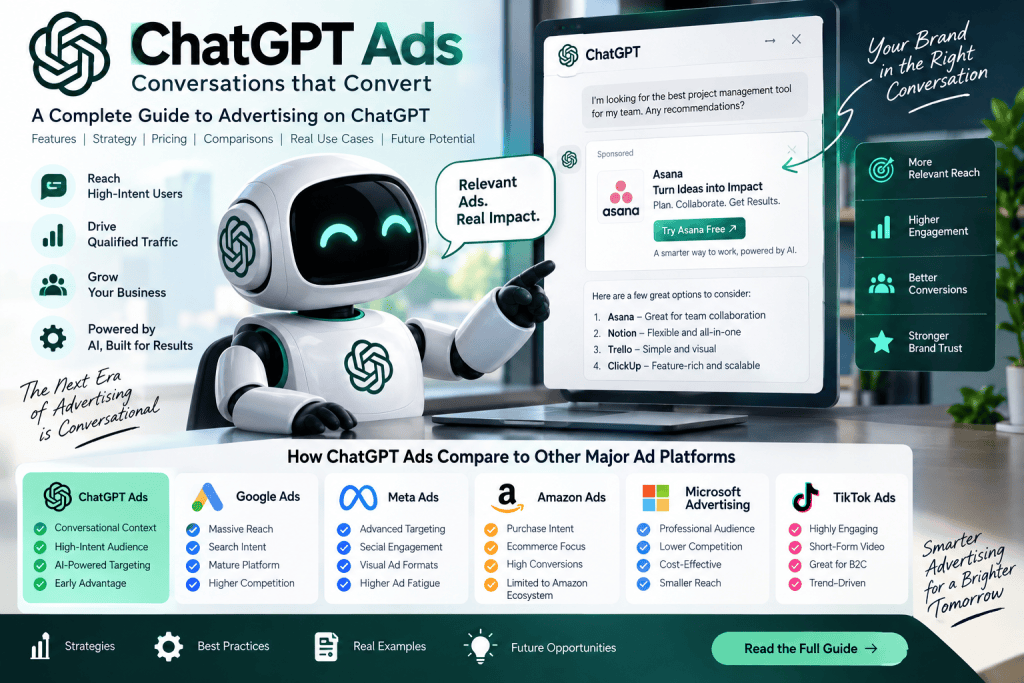
ChatGPT introduces another model: conversation-driven advertising.
This comprehensive guide explains what ChatGPT Ads are, how they work, who can advertise, how pricing works, how to create campaigns, how targeting differs from traditional advertising platforms, how conversion tracking works, and when ChatGPT Ads may be better—or worse—than Google Ads, Meta Ads, Microsoft Advertising, Amazon Ads, or TikTok Ads.
Important: ChatGPT Ads are still an evolving advertising platform. Features, availability, policies, campaign objectives, measurement capabilities, and supported markets can change as OpenAI expands the system.
What Are ChatGPT Ads?
ChatGPT Ads are paid advertisements displayed within the ChatGPT experience, allowing businesses to reach users while they explore options, compare products or services, and make decisions.
OpenAI describes ChatGPT advertising as an AI-native advertising environment built around the conversational context of the user’s interaction. Ads can be selected using signals such as the current conversation, conversational intent, the advertiser’s landing page, ad title and copy, advertiser-provided context hints, and—when advertising personalization is enabled—selected signals from a user’s broader ChatGPT experience.
This distinction is important.
Traditional search advertising generally starts with:
Keyword → Search → Advertisement
ChatGPT advertising can instead operate more like:
Conversation → Intent → Context → Relevant Advertisement
For example, imagine a person asks:
“What should I consider when choosing accounting software for a small business?”
The user isn’t necessarily searching for a particular company.
They are researching.
Another user might ask:
“Compare affordable website hosting options for a small business.”
Again, the user is expressing an explicit decision-making intent.
This makes ChatGPT particularly interesting for advertisers whose products can naturally solve problems discussed during conversations.
Why ChatGPT Ads Matter
The biggest opportunity isn’t simply that ChatGPT has a large user base.
The more important opportunity is intent density.
A traditional display impression may tell an advertiser very little about what the person actually wants.
A conversation can contain substantially more contextual information.
A user may explain:
- what problem they have;
- what they have already tried;
- their budget;
- their location;
- their preferences;
- the features they need;
- the alternatives they are considering;
- and what decision they are trying to make.
OpenAI says ChatGPT Ads can use conversational intent and context signals to determine relevance. Advertisers can also provide context hints describing conversations, topics, or keywords where their products may be relevant. These hints guide matching but are not exact-match keywords and do not guarantee delivery.
That creates a potentially powerful new category:
Intent-based conversational advertising
The difference is subtle but important.
Google asks:
“What did this person search for?”
Social platforms can ask:
“Who is this person likely to be interested in?”
Conversational advertising can ask:
“What is this person trying to accomplish right now?”
That could become one of the most important developments in digital advertising.
How ChatGPT Ads Work
ChatGPT Ads are designed to appear separately from ChatGPT’s generated responses.
According to OpenAI’s current documentation, ads can appear below ChatGPT responses and include:
- advertiser name;
- advertiser favicon/logo;
- headline;
- description;
- landing page;
- image creative.
OpenAI states that ads are clearly labeled and remain separate from ChatGPT’s answers.
This separation is strategically important.
An advertiser does not purchase control over ChatGPT’s response.
The advertisement is an independent commercial placement.
Therefore:
ChatGPT answer ≠ advertisement
and
advertisement ≠ ChatGPT recommendation.
This distinction is central to the platform’s advertising model.
Where Do ChatGPT Ads Appear?
ChatGPT Ads can appear within the ChatGPT experience, generally below responses where eligible advertising inventory is available.
The exact placement and delivery can depend on:
- campaign eligibility;
- user eligibility;
- conversation context;
- ad relevance;
- campaign objective;
- advertiser targeting;
- auction dynamics;
- policy restrictions;
- platform availability.
OpenAI’s current advertising documentation describes the system as designed to show relevant ads while users explore, compare, and decide.
Advertisers should therefore think of ChatGPT as a contextual conversational environment, not simply another advertising website.
Who Can See ChatGPT Ads?
ChatGPT advertising availability differs according to the user’s plan and eligibility.
OpenAI currently states that ads may appear for users on Free and Go plans.
Ads are not shown to users on:
- Plus;
- Pro;
- Business;
- Enterprise;
- Edu.
OpenAI also states that ads are not shown to accounts identified as belonging to people under 18.
This creates an important difference from many traditional advertising platforms.
Advertisers are not simply buying access to “all ChatGPT users.”
They are buying access to eligible advertising inventory within ChatGPT.
Is ChatGPT Ads Available in India?
Yes.
OpenAI’s current Ads Manager availability documentation lists India as available for self-service Ads Manager access. Availability can change as the program expands, so advertisers should verify the latest country eligibility before creating a campaign.
For Indian businesses, this is particularly significant because ChatGPT advertising can potentially complement established channels such as:
- Google Ads;
- Meta Ads;
- Microsoft Advertising;
- Amazon Ads;
- LinkedIn advertising;
- YouTube advertising;
- TikTok advertising.
However, businesses should not automatically move their entire advertising budget to ChatGPT.
The better strategy is to test it as an additional acquisition channel and compare its economics against existing campaigns.
How ChatGPT Ad Targeting Works
This is one of the most important concepts to understand.
ChatGPT Ads do not simply copy the traditional keyword-targeting model.
OpenAI says its system considers multiple relevance signals, including:
- current conversation context;
- conversational intent;
- landing page;
- ad title;
- ad copy;
- advertiser-provided context hints;
- selected broader ChatGPT signals when ad personalization is enabled.
Context hints
Advertisers can provide hints about the conversations, topics, or keywords in which their offering may be relevant.
However, these are not equivalent to Google’s exact keyword targeting.
That means an advertiser should avoid thinking:
“I will target the exact phrase ‘best accounting software’.”
A better approach is:
“My software helps small businesses manage bookkeeping, invoicing, expenses, reporting, and financial administration.”
The second approach gives the system a broader understanding of the business’s usefulness.
ChatGPT Ads vs Keyword Advertising
Traditional keyword advertising works exceptionally well when people already know what they want.
Consider:
“buy running shoes online”
That is explicit search intent.
ChatGPT conversations can be broader:
“I’m starting running again after five years. What type of shoes should I buy for three runs a week?”
The second interaction contains richer contextual information.
The user may be:
- researching;
- comparing;
- learning;
- evaluating;
- seeking recommendations;
- narrowing down choices.
This is why ChatGPT Ads can be particularly interesting for products that require consideration before purchase.
ChatGPT Ads Pricing and Bidding
ChatGPT Ads currently supports multiple buying models.
OpenAI’s current documentation identifies:
- CPM — cost per thousand impressions;
- CPC — cost per click;
- oCPC — conversion-optimized cost per click.
CPM
With CPM, advertisers pay based on impressions.
This is generally appropriate for:
- reach;
- awareness;
- visibility;
- brand-building.
CPC
With CPC, advertisers pay for valid clicks.
This is generally better suited to:
- website traffic;
- product exploration;
- lead generation;
- consideration.
oCPC
Conversion-optimized CPC is designed to optimize delivery toward downstream conversion actions.
This can become especially useful when an advertiser has enough reliable conversion data.
OpenAI’s current guidance recommends starting CPC maximum bids in the range of $3–$5 USD per click, although this is guidance rather than a universal price and actual delivery costs depend on auction conditions and campaign settings.
Advertisers should not confuse a recommended starting bid with an expected average CPC.
Actual results can vary considerably.
How the ChatGPT Ads Auction Works
OpenAI states that it uses a relevance-weighted, second-price auction among eligible ads. The system aims to maximize both advertiser and user value.
This means the highest bid does not automatically guarantee success.
Relevance matters.
That makes sense in a conversational environment.
An irrelevant advertisement could damage the user experience even if an advertiser is willing to pay more.
Therefore, advertisers should focus on:
Bid + relevance + usefulness + conversion quality
rather than:
Bid alone.
ChatGPT Ads Manager
OpenAI Ads Manager Beta is the platform for creating, launching, managing, and measuring ChatGPT advertising campaigns.
Current capabilities include:
- campaign creation;
- ad-group management;
- ad management;
- budget management;
- reporting;
- CSV exports;
- account settings;
- billing;
- permissions;
- API keys;
- campaign monitoring.
The platform remains in beta, meaning advertisers should expect the interface and capabilities to evolve.
For agencies, this is important.
A successful ChatGPT Ads service should not be built around memorizing today’s interface.
Instead, agencies should build a repeatable framework around:
- customer research;
- conversational intent;
- positioning;
- creative testing;
- landing pages;
- conversion measurement;
- experimentation;
- optimization.
How to Create a ChatGPT Ad Campaign
A practical ChatGPT Ads workflow looks like this.
Step 1: Define the business objective
Start with one clear objective.
Examples:
- generate leads;
- sell products;
- increase website traffic;
- build awareness;
- generate registrations;
- acquire new customers.
Avoid combining multiple unrelated goals in a single campaign.
Step 2: Identify your highest-value customer problems
Don’t start with keywords.
Start with problems.
For example, a website development company might identify:
- “I need a business website.”
- “My existing WordPress website is slow.”
- “I need an ecommerce website.”
- “How much does a professional website cost?”
- “How can I improve my website SEO?”
These represent different conversational situations.
Step 3: Build relevant ad groups
Group closely related customer problems together.
For example:
Ad Group: WordPress Website Development
Potential context:
- WordPress website;
- business website;
- WordPress redesign;
- website developer;
- WordPress development;
- website maintenance.
Then create multiple ads addressing different benefits.
Step 4: Create several creative variations
OpenAI recommends building coverage rather than relying on one advertising message.
Its current guidance encourages multiple title and copy variations with distinct angles.
For example:
Variation A — Speed
“Fast WordPress Websites for Growing Businesses”
Variation B — Business outcome
“Turn Your Website Into a Better Sales Channel”
Variation C — Professional service
“Professional WordPress Development & Support”
Variation D — Specific problem
“Need a Faster, Better WordPress Website?”
Each variation should communicate a different value proposition rather than simply changing a few words.
How to Write High-Performing ChatGPT Ads
ChatGPT advertising requires a different copywriting philosophy.
Traditional advertising often emphasizes:
- clever slogans;
- emotional hooks;
- urgency;
- broad claims;
- aggressive calls to action.
ChatGPT advertising should emphasize clarity and usefulness.
OpenAI recommends clear, specific, benefit-focused copy.
A strong ChatGPT advertisement should answer:
What do you offer?
Be specific.
Who is it for?
Identify the relevant customer.
Why does it matter?
Explain the practical benefit.
What should the customer do next?
Use a clear CTA.
A Simple ChatGPT Ads Copy Formula
Use:
Problem + Solution + Benefit + Action
For example:
“Need a professional business website? Get a fast, mobile-friendly WordPress website designed for better credibility, leads, and growth. Explore our website solutions.”
This is more useful than:
“Transform Your Digital Future Today!”
The second statement sounds like advertising.
The first tells the customer what they actually receive.
ChatGPT Ads Landing Pages
Your advertisement is only the beginning.
If your ad says:
“Affordable WordPress website development”
but the landing page says:
“Enterprise Digital Transformation Solutions”
you create a messaging mismatch.
The landing page should reinforce:
- the problem;
- the solution;
- the promised benefit;
- proof;
- pricing or next steps;
- FAQs;
- trust signals;
- CTA.
This is especially important because OpenAI’s ad selection system considers the landing page as one of the relevance signals.
ChatGPT Ads Conversion Tracking
Performance advertising requires measurement.
OpenAI currently supports conversion measurement using:
- OpenAI Pixel;
- Conversions API;
- or both.
Advertisers can track actions such as:
- purchases;
- lead submissions;
- registrations;
- account creation;
- other standard or custom events.
The system can use an OpenAI click reference, called oppref, to associate conversion activity with advertising clicks.
For stronger measurement, OpenAI recommends combining browser-based Pixel tracking with server-side Conversions API signals where appropriate.
Why Conversion Tracking Matters
Suppose you spend $500.
You receive:
- 10,000 impressions;
- 300 clicks;
- 15 leads;
- 3 customers.
Without conversion tracking, you might conclude:
“The campaign generated traffic.”
With proper measurement, you can calculate:
Cost per lead = $500 ÷ 15 = $33.33
Cost per customer = $500 ÷ 3 = $166.67
If each customer generates $500 in gross profit, the campaign may be economically attractive.
This is much more meaningful than CTR alone.
ChatGPT Ads Measurement
Current Ads Manager reporting includes metrics such as:
- impressions;
- clicks;
- spend;
- CTR;
- average CPC;
- average CPM;
- conversions.
CSV exports are also available.
Advertisers should evaluate campaigns through a funnel.
Level 1: Delivery
- impressions;
- reach;
- spend.
Level 2: Engagement
- clicks;
- CTR;
- CPC.
Level 3: Conversion
- leads;
- registrations;
- purchases;
- CPA.
Level 4: Business outcome
- revenue;
- gross profit;
- customer lifetime value;
- ROAS.
A campaign with a high CTR but poor conversion rate is not necessarily successful.
ChatGPT Ads Privacy
Privacy is one of the most important differentiators of ChatGPT advertising.
OpenAI states that advertisements remain separate from ChatGPT’s responses and that advertisers do not receive users’ private conversations simply because an advertisement is shown.
OpenAI also provides users with controls concerning how advertising personalization works.
For advertisers, this means the goal should not be to obtain personally identifiable conversational data.
The opportunity is to reach relevant commercial contexts, while the platform maintains separation between advertising and ChatGPT responses.
ChatGPT Ads Brand Safety
Brand safety is particularly important because advertisements can otherwise appear beside sensitive conversations.
OpenAI says its advertising safeguards are designed to avoid placements in sensitive and brand-unsafe contexts. These include categories involving areas such as:
- self-harm;
- weapons;
- terrorism;
- fraud;
- hate;
- misinformation;
- political content;
- regulated goods;
- privacy;
- certain vulnerable or emotionally sensitive interactions.
This is a major consideration for advertisers.
The objective is not simply to maximize impressions.
It is to maximize useful, brand-safe impressions.
ChatGPT Ads vs Google Ads
Google Ads remains one of the strongest advertising platforms for explicit search intent.
Google’s auction considers factors including:
- bid;
- ad quality;
- landing page quality;
- expected impact of assets;
- Ad Rank thresholds;
- search context;
- auction competitiveness.
Google Ads strengths
Google is excellent for:
- direct purchase intent;
- local searches;
- branded searches;
- service searches;
- ecommerce;
- keyword-level control;
- mature reporting;
- broad inventory.
Example:
“WordPress developer near me”
This is extremely strong commercial intent.
ChatGPT Ads strengths
ChatGPT can be more interesting when the user is still deciding.
Example:
“What should I look for when hiring a WordPress developer?”
The person may not have chosen a provider yet.
Verdict
Google Ads wins for explicit search demand.
ChatGPT Ads may have an advantage for conversational research and consideration.
The two platforms can therefore be complementary rather than mutually exclusive.
ChatGPT Ads vs Meta Ads
Meta’s advertising ecosystem spans Facebook, Instagram, Messenger and other placements, with sophisticated audience and creative optimization.
Meta’s system supports broad automated placements, creative optimization, and auction-based delivery.
Meta strengths
Meta is particularly strong for:
- visual advertising;
- social discovery;
- lifestyle brands;
- video;
- creator-driven marketing;
- retargeting;
- audience-based campaigns;
- ecommerce.
ChatGPT strengths
ChatGPT is fundamentally different because the user is actively engaged in a conversational task.
Meta often interrupts or integrates with content consumption.
ChatGPT can place an advertisement in the context of an active problem-solving session.
Verdict
Meta is excellent for discovery and visual storytelling.
ChatGPT is potentially stronger for contextual consideration and decision-making.
ChatGPT Ads vs Microsoft Advertising
Microsoft Advertising provides search advertising through Bing and partner networks, alongside audience advertising.
Microsoft Search Ads are designed to reach people searching for products, services, or information.
Microsoft also provides audience targeting capabilities, including in-market audiences and LinkedIn profile-based targeting such as company, industry, and job function.
Microsoft strengths
- search advertising;
- audience targeting;
- LinkedIn professional signals;
- potentially lower competition in some auctions;
- strong integration with Microsoft’s ecosystem.
ChatGPT strengths
- conversational context;
- AI-native environment;
- decision-oriented interactions;
- context beyond conventional search keywords.
Verdict
Microsoft is particularly useful as a complementary search channel.
ChatGPT represents a newer conversational advertising category.
ChatGPT Ads vs Amazon Ads
Amazon Ads has a major structural advantage:
Amazon knows the user is shopping on Amazon.
Sponsored Products are CPC advertisements that can appear within shopping results and product pages.
Amazon is therefore exceptionally strong for:
- product discovery;
- ecommerce;
- shopping intent;
- product comparison;
- marketplace sales.
ChatGPT has a broader use case.
A user might be researching:
“What laptop should I buy for programming?”
That is purchase consideration, but the user may not yet be shopping on a marketplace.
Verdict
Amazon Ads is extremely powerful for marketplace commerce.
ChatGPT Ads may be more valuable earlier in the consideration journey.
For ecommerce brands, using both could potentially cover:
Research → Consideration → Shopping → Purchase
ChatGPT Ads vs TikTok Ads
TikTok is fundamentally a content and entertainment environment.
TikTok provides targeting based on factors including interests, behaviors, communities, location, and device type, alongside custom and lookalike audiences.
TikTok excels at:
- short-form video;
- product discovery;
- creator marketing;
- entertainment;
- trend-driven demand;
- visual storytelling.
ChatGPT is more appropriate for:
- research;
- comparison;
- explanation;
- planning;
- problem solving;
- decision support.
Verdict
TikTok can create demand.
ChatGPT can potentially capture people already thinking about a problem or decision.
ChatGPT Ads vs Major Advertising Platforms
| Feature | ChatGPT Ads | Google Ads | Meta Ads | Microsoft Ads | Amazon Ads | TikTok Ads |
|---|---|---|---|---|---|---|
| Primary environment | AI conversation | Search/web | Social | Search/web | Ecommerce | Social/video |
| Core signal | Conversational context | Search intent | Audience/content | Search + audience | Shopping intent | Interest/behavior/content |
| Strongest stage | Research/consideration | Intent/action | Discovery/consideration | Intent/action | Purchase | Discovery |
| Keyword targeting | Context hints rather than traditional exact keywords | Strong | Limited/indirect | Strong | Keyword/product targeting | Not core |
| Visual creative | Yes | Yes, depending campaign | Very strong | Yes | Yes | Extremely strong |
| Ecommerce | Emerging | Strong | Strong | Strong | Excellent | Strong |
| B2B | Potentially useful | Excellent | Useful | Strong | Limited | Variable |
| Local services | Potentially useful | Excellent | Strong | Strong | Weak | Variable |
| CPC | Yes | Yes | Yes | Yes | Yes | Yes |
| CPM | Yes | Yes | Yes | Yes | Some formats | Yes |
| Conversion measurement | Yes | Mature | Mature | Mature | Mature | Mature |
| Conversational intent | Core differentiator | Limited | Limited | Emerging | Limited | Limited |
| Platform maturity | Emerging | Very mature | Very mature | Mature | Mature | Mature |
The most important takeaway is that ChatGPT Ads should not initially be viewed as a replacement for every other advertising channel.
Its strategic value comes from its unique environment.
Advantages of ChatGPT Ads
1. Conversational intent
The platform can understand more than a short keyword.
2. Decision-making context
Users often explain what they need before choosing a solution.
3. AI-native environment
Advertising is integrated into an AI-driven workflow rather than simply added to a search results page or social feed.
4. New inventory
Because the ecosystem is relatively young, early advertisers may have opportunities to learn before the market becomes more crowded.
5. Multiple pricing models
CPM, CPC, and conversion-oriented options provide flexibility.
6. Conversion measurement
Pixel and server-side measurement options support performance marketing.
7. Strong relevance potential
Ads can be matched to conversational context rather than depending solely on keywords.
Limitations of ChatGPT Ads
ChatGPT Ads also have important limitations.
1. The platform is still evolving
Ads Manager remains in beta.
2. Less historical data
Google and Meta have decades of advertising ecosystem development behind them.
3. Less mature optimization
Some advanced capabilities advertisers expect from established platforms may still be developing.
4. Smaller advertising ecosystem
There are fewer established agencies, benchmarks, integrations, case studies, and best-practice libraries.
5. Uncertain economics
Early CPC and conversion benchmarks should not automatically be assumed to represent long-term market pricing.
6. Policy limitations
Certain sensitive and regulated categories have restrictions or may require approval.
Who Should Advertise on ChatGPT?
ChatGPT Ads can be particularly interesting for businesses where customers research before purchasing.
Potential categories include:
- SaaS;
- software;
- education;
- professional services;
- travel;
- consumer products;
- household products;
- technology;
- ecommerce;
- local services;
- digital services;
- business tools.
OpenAI’s current policies focus initial advertising availability primarily around consumer categories such as lifestyle and household goods, local services, travel and experiences, digital products, and education, with some regulated categories subject to gradual approval.
ChatGPT Ads Strategy for Small Businesses
Small businesses should not start by spending a large budget.
Start with a controlled experiment.
Recommended approach
Step 1
Choose one high-margin product or service.
Step 2
Identify 5–10 customer problems.
Step 3
Create several distinct ad messages.
Step 4
Build a focused landing page.
Step 5
Install conversion tracking.
Step 6
Launch with a controlled budget.
Step 7
Evaluate:
- CPC;
- CTR;
- conversion rate;
- CPA;
- revenue;
- profit.
Step 8
Scale only when economics are proven.
ChatGPT Ads Strategy for Agencies
Agencies have an especially interesting opportunity.
Instead of simply selling:
“ChatGPT Ads management”
an agency can build a broader service:
Conversational Demand Generation
The service could include:
- customer research;
- intent mapping;
- campaign architecture;
- ad creative;
- landing-page optimization;
- tracking;
- analytics;
- experimentation;
- monthly reporting.
This is more defensible than merely operating an Ads Manager interface.
ChatGPT Ads Strategy for Ecommerce
Ecommerce businesses should connect advertising with product economics.
Focus on:
- product margin;
- average order value;
- conversion rate;
- repeat purchase;
- customer lifetime value.
For example:
If your average order value is ₹2,500 and gross margin is 40%, your gross profit per order is approximately:
₹2,500 × 40% = ₹1,000
If customer acquisition costs ₹400, the campaign may be attractive.
If acquisition costs ₹1,500, the same campaign could be unprofitable unless repeat purchases make up the difference.
Never optimize ecommerce advertising around CTR alone.
ChatGPT Ads Strategy for SaaS Companies
SaaS businesses should emphasize problems and outcomes.
Instead of:
“Our AI-powered CRM uses advanced technology.”
Try:
“Need a simpler CRM for a growing sales team? Manage leads, follow-ups, and customer activity from one workspace.”
The second message explains usefulness.
SaaS advertisers should track:
- free trials;
- demos;
- registrations;
- qualified leads;
- activated users;
- paid conversions;
- customer acquisition cost;
- lifetime value.
Common ChatGPT Ads Mistakes
Mistake 1: Treating ChatGPT like Google
ChatGPT isn’t simply a keyword search engine.
Think conversationally.
Mistake 2: Using generic advertising language
“Unlock your potential.”
“Transform your future.”
“Experience excellence.”
These phrases communicate little.
Be specific.
Mistake 3: Using only one creative
Different customers have different motivations.
Create multiple meaningful variations.
Mistake 4: Sending users to the homepage
A dedicated landing page often creates a clearer journey.
Mistake 5: Ignoring conversion tracking
Traffic isn’t the final objective.
Revenue is.
Mistake 6: Overpromising
Advertising claims must accurately represent the product and landing page.
OpenAI’s policies require consistency across ad assets and destinations.
Mistake 7: Scaling too quickly
Early platform data can be noisy.
Test first.
Scale second.
ChatGPT Ads Best Practices
1. Start with intent
Ask:
What problem is the customer trying to solve?
2. Build several ad angles
Test:
- price;
- speed;
- convenience;
- quality;
- expertise;
- features;
- outcome;
- trust.
3. Make every ad useful
The best ChatGPT advertisement should feel like a relevant answer to the situation.
4. Match the landing page
Your ad promise and landing-page promise should be consistent.
5. Track real business outcomes
Measure:
Spend → Click → Lead → Customer → Revenue
6. Use first-party measurement properly
Use Pixel and Conversions API where appropriate and legally permitted.
7. Test before scaling
A small controlled experiment is more valuable than a large uncontrolled campaign.
8. Keep creative variations genuinely different
OpenAI specifically recommends distinct messaging rather than repetitive variations.
The Future of AI-Native Advertising
ChatGPT Ads may represent the beginning of a broader change in digital advertising.
For decades, advertising has largely been organized around:
Web pages + search queries + social feeds + audiences.
AI assistants introduce another environment:
Conversation + context + intent + action.
The user may no longer need to visit ten websites to research a decision.
They may ask an AI system to:
- explain;
- compare;
- shortlist;
- evaluate;
- calculate;
- plan;
- recommend;
- and eventually act.
That changes the advertising opportunity.
The future may therefore involve advertising not only around what people search for, but around what people are trying to accomplish.
This could lead to a new discipline:
Conversational advertising
Its core principles may include:
- intent understanding;
- contextual relevance;
- useful messaging;
- transparent sponsorship;
- privacy;
- strong measurement;
- AI-assisted optimization.
The brands that learn this environment early may gain valuable experience before conversational advertising becomes as competitive as search and social advertising.
How ChatGPT Ads Could Change SEO and Digital Marketing
ChatGPT Ads do not eliminate SEO.
In fact, they may increase the importance of high-quality digital assets.
Why?
An advertiser needs:
- a credible website;
- clear product information;
- useful landing pages;
- strong positioning;
- accurate claims;
- conversion tracking;
- trustworthy content.
SEO and paid advertising increasingly intersect around the same principle:
Be useful and relevant to the customer’s problem.
For businesses, this means content strategy should increasingly answer real customer questions.
Instead of publishing an article simply because a keyword has search volume, create content around the complete decision journey.
For example:
Awareness
“What is website hosting?”
Research
“How to choose hosting for WordPress”
Comparison
“Managed WordPress hosting vs shared hosting”
Decision
“Best WordPress hosting features for small businesses”
Action
“How to migrate your WordPress website”
This creates a comprehensive information ecosystem.
Should You Advertise on ChatGPT?
There is no universal answer.
ChatGPT Ads may be worth testing if:
- your customers research before buying;
- your product solves a clearly defined problem;
- your landing page is strong;
- you can measure conversions;
- your economics support paid acquisition;
- your industry is eligible;
- you are comfortable experimenting on an emerging platform.
You should be more cautious if:
- your product has extremely low margins;
- your conversion cycle is difficult to measure;
- your audience is highly dependent on visual discovery;
- you need extremely mature attribution;
- your industry faces advertising restrictions.
The Best Strategy: Don’t Choose One Platform
The biggest mistake is asking:
“Should I use ChatGPT Ads or Google Ads?”
The better question is:
“Which platform should handle which part of my customer journey?”
A sophisticated advertising strategy could look like this:
Google Ads
Capture explicit demand.
ChatGPT Ads
Reach customers researching and evaluating solutions.
Meta Ads
Create awareness and retarget audiences.
TikTok Ads
Generate visual discovery and demand.
Microsoft Ads
Capture additional search and audience demand.
Amazon Ads
Capture marketplace shopping intent.
Together, these channels can create a complete acquisition ecosystem.
Frequently Asked Questions About ChatGPT Ads
What are ChatGPT Ads?
ChatGPT Ads are paid advertisements displayed within ChatGPT for eligible users. They allow businesses to reach users while they explore options, compare alternatives, and make decisions.
Are ChatGPT Ads separate from ChatGPT’s answers?
Yes. OpenAI states that advertisements are clearly identified and kept separate from ChatGPT responses.
Who can see ChatGPT Ads?
Ads may appear for Free and Go users. Plus, Pro, Business, Enterprise, and Edu users do not receive ads. OpenAI also excludes accounts identified as belonging to people under 18.
Can businesses advertise in India?
Yes. OpenAI currently lists India as available for self-service Ads Manager access.
How much do ChatGPT Ads cost?
ChatGPT Ads currently support CPM and CPC purchasing, with conversion-oriented campaign options also available. Actual costs depend on auction competition, bids, relevance, campaign objective, and delivery.
Is there a minimum advertising budget?
Advertisers should check the current Ads Manager requirements because platform requirements can evolve. Rather than relying on an assumed universal minimum, evaluate the budget available in the current account interface.
Do ChatGPT Ads use keywords?
Advertisers can provide context hints describing conversations, topics, or keywords where their products may be relevant. These are not exact-match keywords and do not guarantee delivery.
Can I track conversions?
Yes. OpenAI currently supports conversion measurement using the OpenAI Pixel, Conversions API, or both.
Can ChatGPT Ads generate sales?
They can potentially generate clicks and conversions, but performance depends on the product, audience, campaign setup, landing page, creative, offer, auction conditions, and conversion funnel.
Are ChatGPT Ads better than Google Ads?
Not universally.
Google remains exceptionally strong for explicit search intent. ChatGPT offers a different opportunity around conversational research and decision-making.
Are ChatGPT Ads better than Meta Ads?
They solve different problems.
Meta is extremely powerful for visual discovery and audience-based advertising. ChatGPT focuses on conversational context and intent.
Are ChatGPT Ads suitable for small businesses?
Potentially, especially businesses with clearly defined problems, strong landing pages, and measurable conversion events. Start with controlled testing rather than assuming immediate scale.
Is ChatGPT Ads a replacement for SEO?
No.
Paid advertising and organic search/content strategies serve different functions and can complement each other.
Final Verdict: Are ChatGPT Ads Worth Trying in 2026?
ChatGPT Ads are one of the most important emerging developments in digital advertising because they introduce a fundamentally different advertising environment: the AI conversation.
Google Ads is built around search intent.
Meta Ads is built around social discovery and audience signals.
Amazon Ads is built around shopping intent.
TikTok Ads is built around entertainment and visual discovery.
ChatGPT Ads are built around conversation, context, and decision-making.
That does not mean ChatGPT Ads will replace the established advertising giants.
It means advertisers now have another environment in which customers can discover and evaluate businesses.
The strongest strategy is therefore not to abandon Google, Meta, Amazon, Microsoft, or TikTok.
It is to understand what each platform does best.
Use Google when customers already know what they want.
Use Meta when visual discovery and audience-based marketing matter.
Use Amazon when marketplace purchase intent is strongest.
Use TikTok when entertainment and creator-driven discovery are central.
Use Microsoft when additional search and professional audience opportunities make sense.
And test ChatGPT Ads when your customers are asking questions, comparing solutions, researching options, and trying to make decisions.
The companies that succeed in this new environment will probably not be the ones that simply copy their existing advertisements into ChatGPT.
They will be the companies that understand the fundamental difference:
Traditional advertising asks where the customer is. Conversational advertising asks what the customer is trying to accomplish.
That shift—from keywords and audiences toward intent and context—could become one of the defining changes in digital marketing during the AI era.
For businesses willing to experiment, measure carefully, and build genuinely useful advertising experiences, ChatGPT Ads deserve a place in the 2026 digital marketing testing roadmap.
Start small. Measure conversions. Test different messages. Improve the landing page. Compare customer acquisition costs against Google, Meta, and other channels. Then scale only when the numbers prove that the channel works for your business.
That is the most practical way to approach ChatGPT advertising today.
Sources and Further Reading
- OpenAI — Advertise in ChatGPT
- OpenAI Help Center — Ads in ChatGPT: The Basics
- OpenAI Help Center — Ads Manager Availability
- OpenAI Help Center — Conversion Measurement
- OpenAI — Advertising Terms
- OpenAI — Ad Policies
- Google Ads — How Google Ads works
- Microsoft Advertising — Search Ads
- Amazon Ads — Sponsored Ads Guide
- TikTok for Business — Targeting Advertising Guide
Last verified against current public documentation: September 2026.
#ChatGPTAds #ChatGPTAdvertising #OpenAI #OpenAIAds #AIAdvertising #ConversationalAdvertising #AIMarketing #DigitalMarketing #MarketingAI #Advertising #OnlineAdvertising #PerformanceMarketing #PaidAdvertising #AdTech #MarTech #MarketingStrategy #DigitalAdvertising #ContentMarketing #SEO #SEOTips #GoogleAds #MetaAds #AmazonAds #MicrosoftAdvertising #TikTokAds #AdCampaigns #ConversionTracking #LeadGeneration #EcommerceMarketing #SaaSMarketing #BusinessGrowth #MarketingTrends #FutureOfMarketing #AIForBusiness #ArtificialIntelligence #ChatGPT #ChatGPTForBusiness #Technology #TechTrends #DigitalGrowth #MarketingInnovation #MyAdvisers
Discover more from My Advisers
Subscribe to get the latest posts sent to your email.